
Wembley Stadium, London
2-4 November 2026
 United Kingdom
United Kingdom
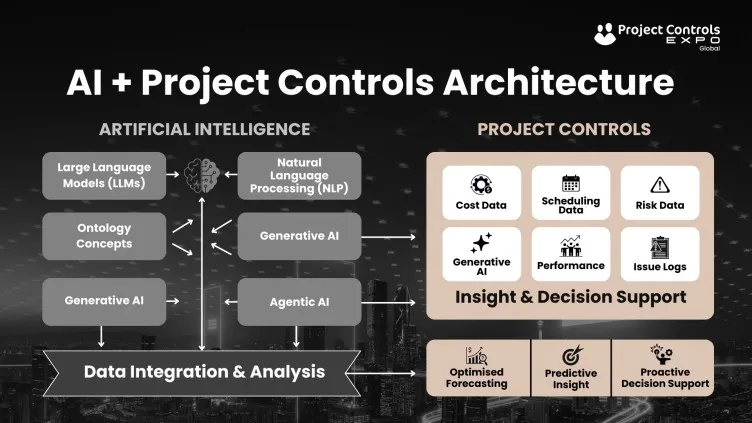
AI and the Project Controls Architecture
Projects are becoming larger, faster, more complex and more data-intensive than at any point in history. Governments are investing billions in infrastructure, organisations are undertaking large-scale digital transformations, and global supply chains are becoming increasingly interconnected.
Yet many Project Controls teams still spend a significant portion of their time collecting data, preparing reports and explaining what has already happened.
At the same time, Artificial Intelligence is rapidly transforming how organisations analyse information, identify patterns and make decisions. This raises a fundamental question for the profession:
What happens when AI becomes capable of analysing project data faster, identifying risks earlier and generating insights automatically?
The answer is not that AI will replace Project Controls professionals. The real shift is far more interesting. AI will change what Project Controls professionals focus on, the skills they need, and the role they play in supporting project leadership.
Those who adapt will become strategic advisors to project leadership. Those who do not risk being left behind by automation.
Projects generate enormous volumes of information:
Traditionally, Project Controls teams have been responsible for consolidating this information and translating it into meaningful insights. But the scale and speed of modern projects are pushing the limits of manual analysis.
Artificial Intelligence changes this dynamic. AI can process vast quantities of structured and unstructured data in seconds, identify patterns across multiple datasets and surface insights that might otherwise remain hidden.
In other words, AI has the potential to transform Project Controls from a data preparation function into an insight-driven discipline.
AI is a broad field, but several emerging technologies are particularly relevant to the future of Project Controls. Understanding these concepts will help professionals navigate the evolving landscape.
Large Language Models are AI systems trained on vast amounts of text data. They are capable of understanding natural language, summarising complex information and generating human-like responses.
In Project Controls environments, LLMs can assist with tasks such as:
LLMs act as knowledge assistants, enabling professionals to process information much faster than before.
Natural Language Processing focuses on enabling machines to understand and analyse human language. Projects generate large amounts of unstructured data, including correspondence, contractor reports, technical documents and meeting discussions.
NLP technologies can analyse these sources to identify:
By converting unstructured information into structured insight, NLP can significantly improve early warning capabilities.
One of the biggest challenges in Project Controls is the fragmentation of project data. Cost information, schedules, risk registers and engineering deliverables often exist in separate systems with limited integration.
Ontologies and knowledge graphs help create structured relationships between these datasets. For example, they can link:
Once these relationships are defined, AI systems can analyse how changes in one area of the project may affect others. This enables more sophisticated forecasting and scenario analysis.
Generative AI refers to systems capable of producing new content such as reports, analyses, simulations or summaries. In Project Controls, generative AI can support:
Rather than replacing professionals, generative AI functions as a co-pilot, accelerating analytical work and allowing professionals to focus on interpretation and decision support.
Agentic AI represents the next stage of AI evolution. Unlike traditional tools that respond to queries, agentic systems can operate autonomously within defined boundaries.
In a Project Controls context, AI agents could:
These agents act as intelligent monitoring systems, helping project teams identify problems before they escalate.
The introduction of AI will not eliminate Project Controls roles. Instead, it will reshape how professionals contribute to project success.
Three major shifts are already emerging.
Today, significant effort is spent collecting, validating and preparing project data. AI will increasingly automate these tasks, freeing professionals to focus on interpreting insights and advising decision makers.
Traditional reports often describe what has already happened. AI-powered analytics can analyse trends and identify early warning signals, enabling Project Controls teams to deliver predictive insights rather than retrospective explanations.
As analytical tools become more capable, the true value of Project Controls professionals will lie in their ability to interpret complex project dynamics, understand commercial and contractual implications, provide balanced judgement and influence leadership decisions. In other words, the profession will move closer to strategic project leadership.
If AI is going to automate parts of the discipline, what will distinguish high-performing professionals? The answer lies in developing a broader skill set that combines technical knowledge, analytical thinking and leadership capability. Several areas will become particularly important.
Future professionals must understand how project data is structured, analysed and interpreted. Understanding data quality, data relationships and analytical outputs will become essential.
Knowing how to interact effectively with AI systems will become a valuable capability. Professionals will need to design effective prompts, evaluate AI-generated outputs and apply them responsibly.
Projects are complex systems with interdependencies across cost, schedule, risk and scope. Understanding these relationships will remain a uniquely human capability that complements AI-driven analysis.
AI can identify patterns, but it cannot fully understand context. Project Controls professionals must apply judgement to determine whether AI-generated insights are realistic or misleading.
As the discipline becomes more decision-focused, professionals must be able to translate complex analysis into clear insights for senior leadership.
The future of Project Controls will not be defined by humans versus machines. Instead, it will be shaped by human–AI collaboration. AI will analyse large datasets, identify patterns and generate preliminary insights. Humans will provide context, judgement and leadership.
Together, this partnership can significantly improve the ability of organisations to manage complex projects and protect investment value.
Artificial Intelligence is likely to become one of the most transformative forces in Project Controls. Handled correctly, it can elevate the profession from a reporting function to a strategic capability that enables better project decisions.
But this shift will require proactive adaptation.
Professionals must begin developing new skills, organisations must rethink how Project Controls teams operate, and the industry must collectively shape how AI is integrated into project environments.
The future of Project Controls will not be determined by technology alone. It will be determined by how the profession chooses to evolve.
Three questions are worth considering:
If AI can analyse project data faster than humans, what should the true role of Project Controls professionals become?
Are we developing the skills needed for an AI-enabled project environment, or still training professionals for yesterday's tools?
How can the industry ensure AI strengthens decision-making rather than simply producing more data and dashboards?
The answers to these questions may well define the next chapter of the Project Controls profession.
United Kingdom


