
Wembley Stadium, London
2-4 November 2026
 United Kingdom
United Kingdom
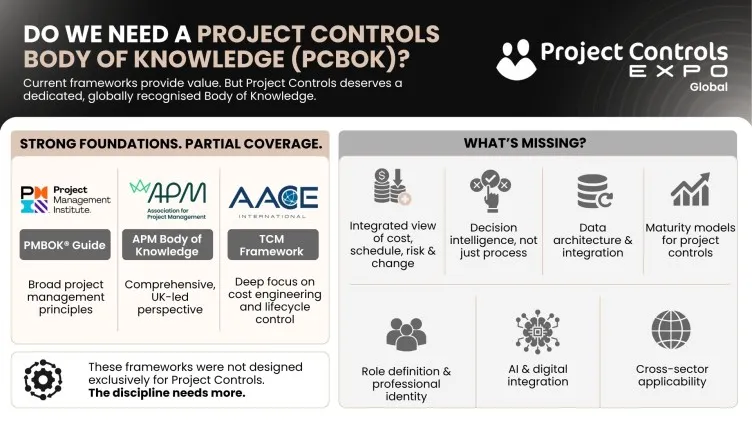
Do We Need a Project Controls Body of Knowledge (PCBOK)?
Project Management has long benefited from established frameworks such as the Project Management Institute's PMBOK® Guide, the Association for Project Management Body of Knowledge, and the AACE International Total Cost Management (TCM) Framework.
Yet, despite these, a fundamental question remains:
Do we have a globally recognised Body of Knowledge that truly represents Project Controls? In my view — not yet.
Existing frameworks provide significant value:
Broad project management principles
Comprehensive, UK-led perspective
Deep focus on cost engineering and lifecycle control
However, these frameworks were not designed exclusively for Project Controls.
As a result, Project Controls often sits:
As a subset of project management
Or a specialism within cost engineering
But rarely as a fully defined, end-to-end discipline in its own right
Through industry discussions and practice, several gaps become evident:
Most frameworks address these elements — but often in silos.
Project Controls requires:
This integration is still weakly defined and inconsistently applied
Current guidance leans heavily on processes and techniques.
What's less developed is:
Modern Project Controls is fundamentally data-driven, yet:
This is a critical gap — especially in an AI-enabled future.
Unlike project management, there is:
This makes it difficult to answer: "How mature is our Project Controls function?"
Project Controls still suffers from:
A unified Body of Knowledge could help:
Current frameworks were not built for:
Yet, this is where the discipline is heading.
A PCBOK must address: How technology augments Project Controls — without diluting its quantitative foundation.
Project Controls varies significantly across:
There is a need for a common foundation with sector-specific adaptability.
The need for a PCBOK is not academic — it is practical.
As projects become larger, more complex, and more data-driven, organisations are asking:
How do we ensure consistent, reliable, and predictable delivery?
Without a unified framework, we risk:
A well-defined Project Controls Body of Knowledge could:
Establish a global standard for the discipline
Provide a common language across industries and regions
Enable consistent maturity assessment
Support education, certification, and career pathways
Integrate data, analytics, and AI into core practice
This is not about replacing existing frameworks.
It's about complementing them — by giving Project Controls the clarity, structure, and recognition it deserves as a discipline.
Project Management defines how we deliver. Project Controls determines whether we will succeed.
Perhaps it's time we formalised that distinction.
United Kingdom


