
Wembley Stadium, London
2-4 November 2026
 United Kingdom
United Kingdom
Path to Zero: Embedding Carbon and Water Neutrality into Heavy Civil Infrastructure Delivery
Embedding Carbon and Water Neutrality into Heavy Civil Infrastructure Delivery
Larsen and Toubro Limited has committed to carbon neutrality by 2040, aligned with the Paris Agreement's 1.5°C pathway. For L&T Heavy Civil Infrastructure — a carbon and water-intensive operational domain — translating this corporate commitment into programme-level controls practice required a fundamental rethinking of how ESG metrics are captured, governed, and acted upon.
L&T HCI strategically focused its neutrality programme on Scope 1 and Scope 2 emissions — the controllable elements of the carbon footprint — recognising that Scope 3 resilience, while important, presented a higher complexity threshold for near-term control. ESG KPIs and KVDs are integrated into monthly and quarterly performance reviews with leadership, ensuring continuous alignment and accountability at the highest level. The programme is governed by a board-level CSR and Sustainability Committee and Environment, Health and Safety Council.
L&T HCI did not treat sustainability as a reporting exercise separate from project controls. ESG performance is embedded in the same governance rhythms, data environments, and accountability structures as schedule, cost, and quality.
The transition from diesel generators to grid electricity — first piloted in 2022 then scaled across multiple sites — reduced diesel consumption by 5% over two years. IoT-based fuel and equipment monitoring enabled real-time insights, optimising asset utilisation and reducing idle time. The IoT fuel tracking system, applied to sub-contracted vehicles, enabled 1.8 million litres of diesel savings.
Solar energy, initially introduced through rooftop panels and solar-powered appliances, was integrated at scale, saving approximately 1,024 MWh. Energy-efficient interventions — Variable Frequency Drives, power factor improvement, sky lighting, star-rated equipment, and energy audits — saved an additional 5,519 MWh and are now mandated across projects.
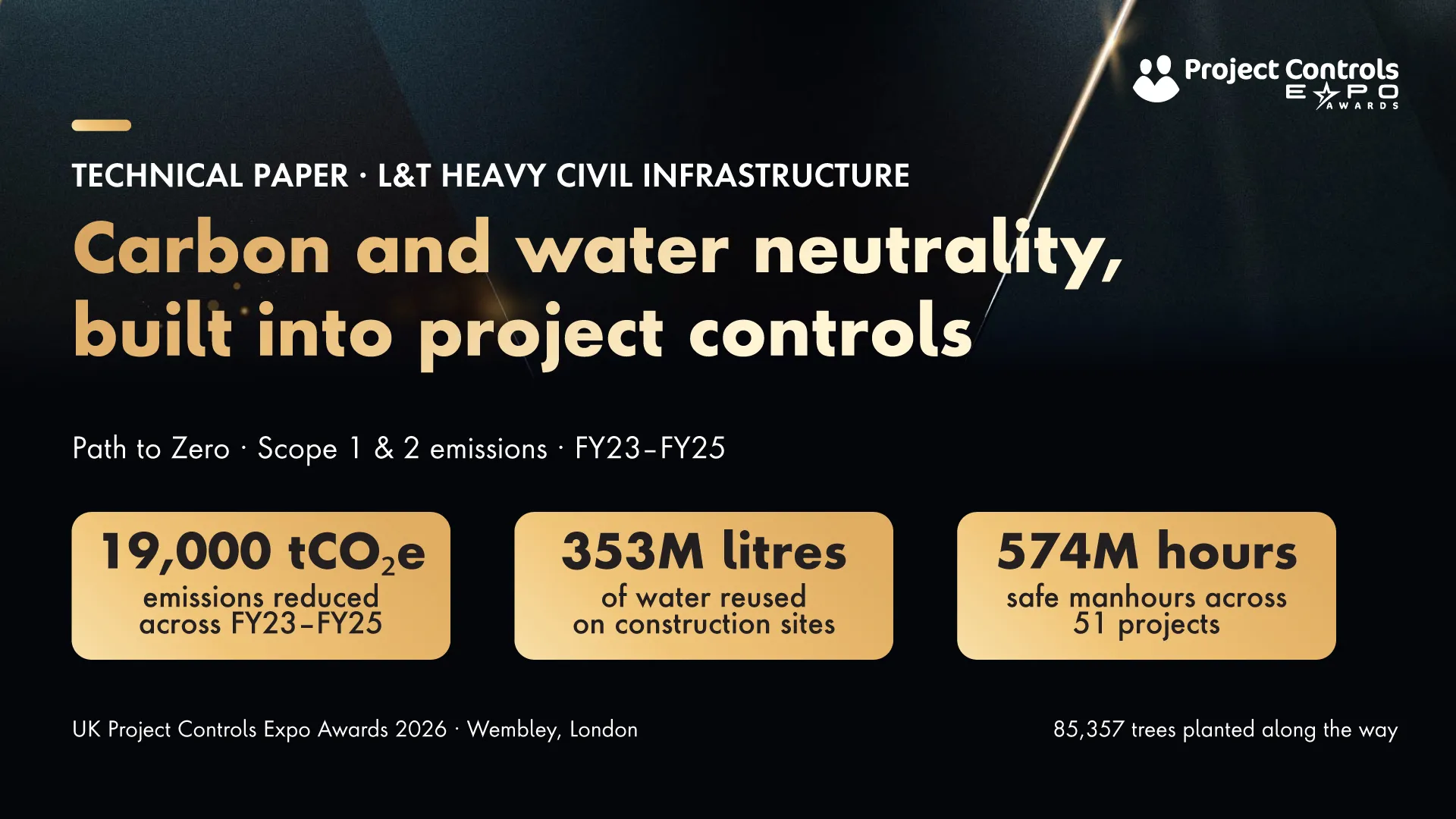
Across FY23–FY25, L&T HCI reduced carbon emissions by 19,000 tCO2e through carbon-focused interventions. Total diesel use reduced by 19%. Freshwater consumption dropped by 13.6%. These are not targets — they are measured, reported outcomes tracked through the programme's ESG governance framework.
Integration of Sewage Treatment Plants, Effluent Treatment Plants, and RO reject water reuse, combined with chemical curing compounds (approved by clients following HCI's data-backed advocacy), enabled the practical reuse of over 353 million litres of water, significantly reducing freshwater dependency. Client approval for STP-treated water use in construction activities was a significant milestone, reducing water consumption by 97,000 KL while adhering to environmental norms.
Construction and demolition waste management was enhanced through on-site crushing and reuse of materials including paver blocks. Steel scrap repurposing, concrete cube reuse, topsoil conservation, and on-site crushers for construction debris reduced material-related emissions and promoted self-sufficiency within the supply chain. These circular practices were promoted through supplier engagement and embedded into execution standards.
Of L&T HCI's top 120 vendors, 88% are certified as 'Green' through internal assessment against sustainability metrics. Vendor evaluation incorporates ESG criteria, and local sourcing of materials is actively promoted. HCI's data-backed engagement with clients and research institutions including IITs and NITs has enabled approval of proven methodologies — demonstrating that supply chain ESG alignment is achieved through evidence, not mandate.
L&T HCI achieved 574 million safe manhours across 51 projects — a safety performance record underpinned by structured safe work practice programmes. Mandatory POSH compliance training was delivered to 9,000 employees. Mindfulness and wellbeing programmes were implemented across sites for 68,000 personnel.
Through CSR initiatives, L&T HCI has supported 6,772 school students, provided medical aid to 20,500 beneficiaries, and delivered skill development support to 3,104 beneficiaries. The programme has planted 85,357 trees and actively conserved biodiversity around project sites — including the rescue and relocation of 18 Mugger crocodiles to safer habitats from a site adjacent to construction activity.
L&T HCI's leadership in sustainable delivery has created a ripple effect — internally, by embedding neutrality targets into project planning as a standard practice; externally, by influencing clients to approve innovative methodologies through data-backed demonstrations, and by encouraging supply chain partners to adopt circular practices. The programme's documented outcomes set a benchmark for responsible infrastructure delivery across the industry.
United Kingdom


