
Wembley Stadium, London
2-4 November 2026
 United Kingdom
United Kingdom
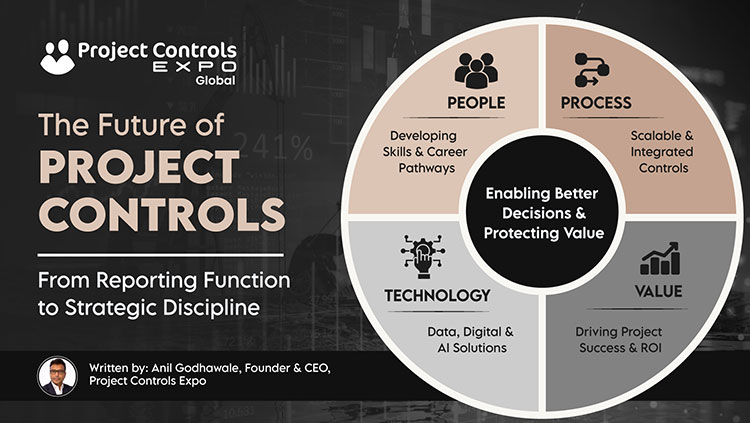
The Future of Project Controls: From Reporting Function to Strategic Discipline.
Projects today sit at the centre of economic growth, infrastructure development, and digital transformation. Governments rely on them to deliver national infrastructure, organisations depend on them to execute strategic change, and investors expect them to generate measurable value.
Yet despite the increasing importance of projects, the profession responsible for protecting delivery performance — Project Controls — is still evolving.
Across industries and regions, the role of Project Controls varies significantly. In some organisations it is deeply embedded in leadership teams, shaping key decisions. In others, it remains confined to reporting dashboards and compliance processes.
This inconsistency raises an important question:
Is the Project Controls profession evolving fast enough to support the future of projects?
To answer this, we need to address three important questions:
Over the last two decades, Project Controls has become a recognised discipline in sectors such as infrastructure, energy, defence and construction. Organisations increasingly understand the need for structured planning, cost management, risk analysis, change control and performance monitoring.
Modern tools now allow project teams to integrate cost and schedule data, track performance in real time, and generate detailed reporting dashboards.
However, despite these advances, the maturity of Project Controls varies widely between organisations.
In many environments, the discipline still faces several structural limitations: It is often perceived primarily as a reporting function rather than a decision-support capability; Controls are frequently over-engineered for small projects and under-developed for complex programmes; Different disciplines such as cost, planning and risk remain fragmented rather than integrated; Technology adoption has accelerated faster than capability development.
As a result, the full potential of Project Controls is not always realised.
The project landscape itself is changing rapidly.
Modern projects are increasingly characterised by:
At the same time, organisations are delivering a wider range of projects — from relatively small digital initiatives to multi-billion-dollar infrastructure programmes.
This diversity creates an important challenge. Project Controls cannot be a one-size-fits-all discipline.
Applying the same controls framework across all projects risks creating unnecessary bureaucracy in smaller initiatives while failing to provide sufficient oversight in complex programmes.
The profession must therefore adopt scalable and proportionate approaches to Project Controls.
Many Project Controls teams still spend the majority of their time producing reports that describe what has already happened. While performance reporting is important, the real value of Project Controls lies in answering more critical questions: What is likely to happen next? What risks could affect delivery? What decisions should leadership consider now? Moving from retrospective reporting to forward-looking insight remains one of the profession's biggest transformations.
In many organisations, planning, cost management, risk management and change control operate as separate functions. Without integration, leadership receives fragmented information rather than a holistic understanding of project performance. Effective Project Controls requires integrated insight across cost, schedule, risk and change.
The skills required for Project Controls are also evolving. Traditional capabilities in scheduling, cost management and risk analysis remain essential. However, modern projects increasingly require professionals who can also bring: Data analytics capability; Digital tool fluency; Strategic thinking; Stakeholder influence; Scenario modelling and forecasting. Developing these capabilities globally will be essential to sustain the profession.
One of the key themes emerging from the Vision Document is the need for proportionate controls based on project complexity.
The profession must recognise that different projects require different levels of control.
Small Projects — Focused on essential planning, cost tracking and risk identification. Lightweight processes, often supported by simple tools.
Complex Projects — Integrated planning, cost, risk and change management supporting structured governance and decision-making.
Major Programmes and Portfolios — Advanced forecasting, portfolio optimisation and strategic decision support across multiple programmes.
This scalable model ensures Project Controls remains both effective and practical across a wide spectrum of projects.
To remain relevant in an increasingly complex project environment, the profession must evolve beyond its traditional role.
The emerging vision is that: Project Controls should become a strategic discipline that enables better decisions, protects value and improves project outcomes.
This vision rests on four interconnected pillars.
A simplified framework for the future of Project Controls can be represented as four pillars:
People | Process | Technology | Value
Developing the next generation of Project Controls professionals through stronger career pathways, multidisciplinary skills and global collaboration.
Creating scalable, proportionate controls frameworks that integrate cost, schedule, risk and change while enabling effective governance.
Using digital tools, data analytics and artificial intelligence responsibly to enhance forecasting and insight.
Positioning Project Controls as a discipline that protects investment value and improves delivery outcomes.
These pillars together help shift Project Controls from a compliance activity to a value-creating capability.
The demand for effective Project Controls has never been greater.
Major infrastructure investments, energy transition programmes, digital transformations and global supply chain challenges all require stronger project delivery capabilities.
If the profession evolves successfully, Project Controls can become a central pillar of project leadership, influencing decisions that shape some of the world's most important investments.
But achieving this future requires collaboration across practitioners, organisations, professional bodies and industry leaders.
The Vision Document and Pathfinder Report being developed through PCAG represent an important step in that journey.
The question now is not whether Project Controls will evolve — it is how quickly and how effectively the profession can shape its own future.
What do you believe the future of Project Controls should look like?
United Kingdom


