
Wembley Stadium, London
2-4 November 2026
 United Kingdom
United Kingdom
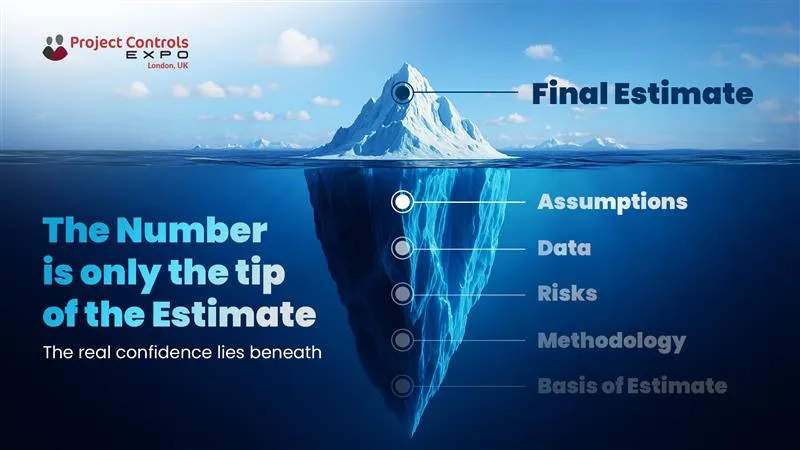
The number is only the tip of the estimate
In project estimation, confidence is often mistaken for precision. Real credibility doesn't come from the figure — it comes from what sits behind it.
If someone asks you to justify your estimate, what do you show? Just the number — or the thinking behind it? In project estimation, confidence is often mistaken for precision. A number that looks exact can create the illusion of certainty. But experienced project professionals know that confidence rarely comes from the number itself. It comes from understanding what sits behind it.
A recent insight shared by Andrew Langridge highlights an important principle in modern estimating:
Credible estimates are built on transparency, not just calculation.
At the heart of this approach is the Basis of Estimate (BoE).
Think of an estimate like an iceberg. What stakeholders see is the final number. But beneath that number lies the real foundation:
Without this context, even a well-calculated figure can quickly lose meaning. For decision-makers, understanding the logic behind the estimate is far more valuable than seeing a precise number alone.
Projects operate in environments filled with uncertainty. Scope evolves, risks materialise, and assumptions change. When estimators clearly communicate how a number was developed, stakeholders gain something far more important than accuracy: clarity.
Transparency allows teams to:
In other words, the estimate becomes a decision-support tool, not just a forecast.
The role of estimation in project controls is evolving. Rather than defending a number, leading organisations are focusing on explaining the reasoning behind it. This shift helps estimators move from being seen as number generators to becoming trusted advisors in project decision-making.
The goal of estimation isn't to eliminate uncertainty — it's to make uncertainty visible and understandable.
And that is where real confidence comes from.
United Kingdom


