
Melbourne Cricket Ground
23-25 November 2026
 Australia
Australia
Digitising Contract and Variation Management at Scale: The CVMS Implementation for Queensland Department of Education
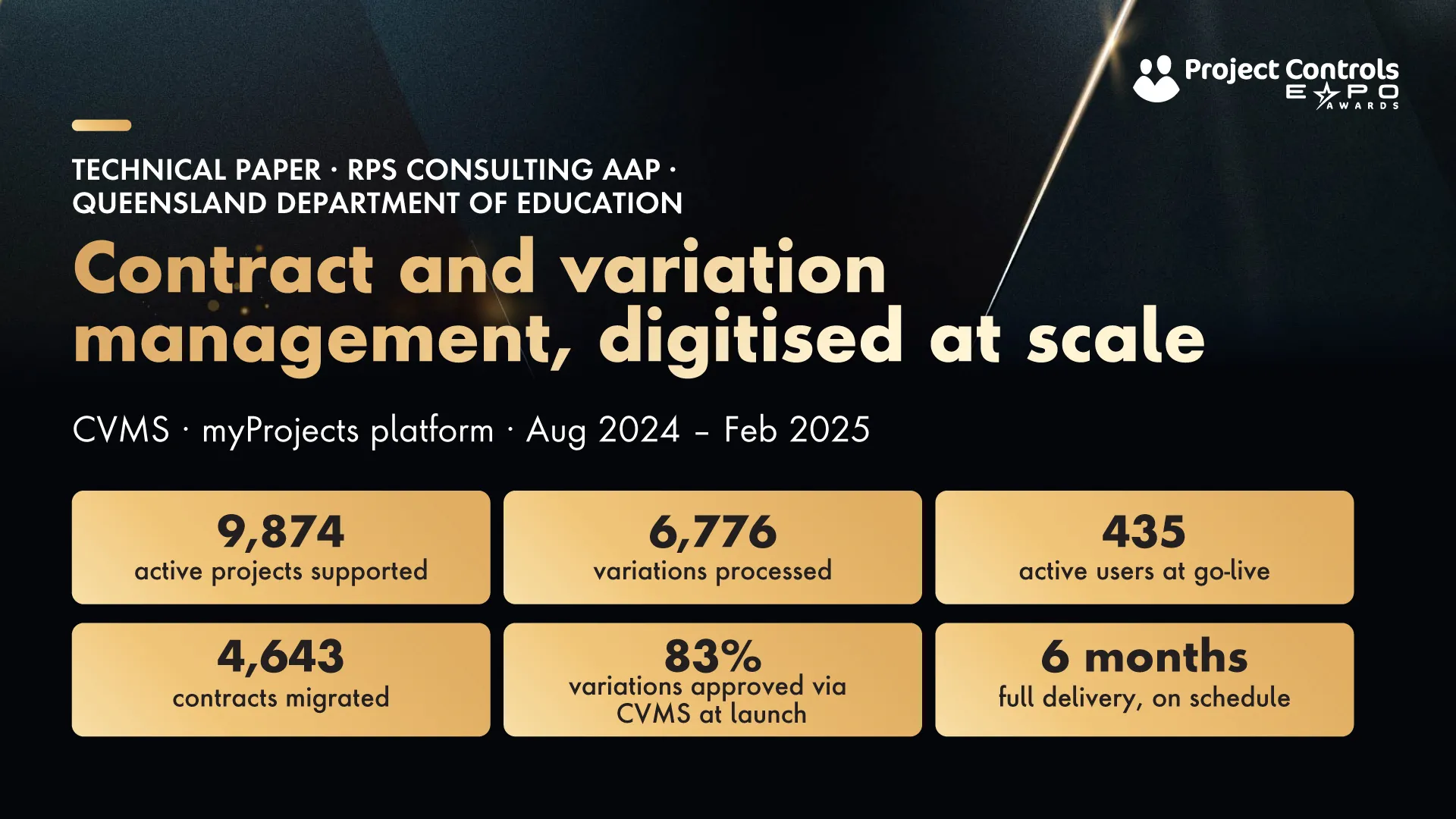
This paper documents the design and implementation of the Contract and Variation Management System (CVMS), a digital platform built within the myProjects portfolio platform for the Queensland Department of Education's Infrastructure Services Division. The Department manages one of Australia's largest public infrastructure portfolios, including more than 9,800 active projects. CVMS replaced spreadsheet-based, decentralised contract and variation processes with a unified, logic-driven platform supporting more than 4,600 contracts and 6,776 variations. Delivered in six months between August 2024 and February 2025, the system went live on schedule with 435 active users at launch. The paper documents the requirements refinement process (which produced 33 versions of the requirements document), the integration with the Department's Legislative Compliance Strategy Assessment, the Variation Assurance Dashboard, and the human-centred change management approach.
Contract management, variation management, Power BI dashboards, agile delivery, public sector digital transformation, embedded compliance
The Queensland Department of Education's Infrastructure Services Division manages one of Australia's largest public infrastructure portfolios. By 2024 the Division was managing thousands of contracts and variations through decentralised, spreadsheet-based processes spanning more than 9,800 active projects. This fragmentation hampered project control, data quality, compliance, and reporting capabilities.
The Department engaged RPS Consulting AAP Pty Ltd to transform the environment by digitising the end-to-end lifecycle of contract and variation management within the existing myProjects portfolio platform. The result was the Contract and Variation Management System (CVMS), a transformative platform built to unify governance, automate compliance, and deliver real-time oversight at scale.
This paper documents the CVMS implementation in four parts. The first part describes the governance and delivery model, including the Department's Better Portfolio and Contract Management team and the role of the Requirements Document in shaping the system. The second part documents the system architecture and the principal innovations: the three custom registers, the two Power BI dashboards, and the logic-driven validation. The third part presents the methodology, the migration approach, and the go-live outcomes. The fourth part discusses lessons learned and the transferability of the model to other public sector contract management environments.
Delivery was driven by the Department's Better Portfolio and Contract Management (BPCM) team in partnership with RPS. A robust engagement model included 33 versions of a Requirements Document, structured workshops, and a shared product roadmap. Agile delivery methods were combined with fixed-date milestones to flex with changing requirements while protecting overall timelines.
The system was closely aligned with the Department's Legislative Compliance Strategy Assessment (LCSA), which required the capture of compliance-related data and full auditability. These requirements were addressed by integrating them directly into the CVMS workflows and dashboards rather than treating them as separate compliance artefacts.
The six-month timeline required disciplined coordination across the Department's Infrastructure Services Division and external contractors. Structured communication, rigorous testing, and transparent decision-making enabled cultural adoption of a systemised contract management approach.
Three custom registers were created — for Contracts, Separable Portions, and Extensions of Time — each configured to align with Queensland Government legislative compliance and the Department's internal frameworks. The registers enable scalable contract lifecycle tracking and real-time reporting.
Two new Power BI dashboards consolidate the data. The CVMS Dashboard provides role-specific insight across contracts, projects, and variations, mapping data from multiple sources. The Variation Assurance Dashboard performs dozens of automated data integrity checks on every record to support compliance and data integrity.
Logic-driven Power BI dashboards automated validation, compliance checks, approval workflows, and cost forecasting in real time. Embedded business rules automate cost calculations, status updates, quality assurance checks, and issue alerts. The dashboards function as the operational interface for users rather than as a separate reporting layer.
The Variation Assurance Dashboard is the principal compliance instrument within CVMS. Each variation record is subject to multiple automated data integrity checks at the point of entry and on update. Checks cover field completeness, cost calculation consistency, approval state progression, and alignment with the parent contract. Records failing any check are flagged in the dashboard for remediation.
The dashboard serves three audiences simultaneously. Contract managers use it to identify records requiring attention. Quality assurance reviewers use it to confirm that compliance requirements are being met systematically rather than case-by-case. External auditors use it as the evidence base for compliance assurance, with the audit trail tracking who made which change and when. The single dashboard therefore replaces three previously separate review processes.
Business requirements were mapped and confirmed through collaborative development of a 166-element specification across 128 data fields, covering Contracts, Separable Portions, and Extensions of Time. Visual mock-ups of dashboards translated abstract requirements into tangible artefacts, enabling stakeholders to understand system behaviour and contribute meaningfully to design decisions.
Testing was rigorous and included User Acceptance Testing (UAT), regression testing, and product verification testing, all guided by a detailed 80-point migration checklist. Contract data migration was fully scripted and verified, ensuring no downtime and full system continuity at cutover.
Azure DevOps was used as the development platform, enabling seamless task handover within the internal team of managers, analysts, and developers, and preserving transparency on quality assurance and testing outcomes across stream-specific boards.
The visual mock-up approach merits separate attention as a methodological contribution. By translating abstract requirements into tangible visual artefacts before development began, the team enabled stakeholders who lacked technical fluency to participate substantively in design decisions. Stakeholders could see the proposed user interface, react to it, and propose changes in concrete terms. This contributed directly to the rapid stakeholder buy-in and to the comparatively low rate of late-stage requirements change.
Migration covered more than 4,600 contracts and approximately 6,800 variations across nearly 9,900 projects. The 80-point migration checklist included post-migration data reconciliation and access validation. Following go-live on 28 February 2025, 83% of variations were already approved through the new platform.
User adoption was rapid. Within weeks of go-live, more than 430 users were trained, onboarded, and transitioned to using CVMS in their business-as-usual activities. Targeted training, ongoing communications, and an active support request register supported the transition.
Migration of contract data was managed through fully scripted, repeatable processes rather than manual cutover. Scripts performed validation in both the source data set and the migrated CVMS records, with reconciliation reports issued after each migration batch. This approach allowed the migration to be dry-run multiple times against a representative sample before the cutover, reducing the risk that go-live would surface previously unseen data issues.
Real-time dashboards reduced human handling and improved decision-making. Logic-based validation and error-checking enabled multiple data integrity checks per record on the Variation Assurance Dashboard. Governance workflows enabled clear escalation paths and audit trails aligned to departmental and Queensland Government frameworks.
The system supported 64 programs, 9,874 projects, 4,643 contracts, and 6,776 variations (with 5,689 approved) shortly after go-live. There were 435 active users, with adoption continuing to grow. The platform demonstrated strong scalability across diverse user types from executives to contract managers.
The principal lesson concerned the value of early stakeholder alignment and iterative engagement. By involving project coordinators, program managers, and infrastructure delivery teams from the outset, the project avoided disconnects between user needs and system outputs.
A second lesson concerned the importance of visual engagement. Visual mock-ups proved essential to communicate system logic and to elicit valuable feedback at each iteration. Bringing ideas to life visually was identified as one of the strongest contributors to the quality of each successive iteration.
A third lesson concerned the relationship between flexibility and structure. The 33 versions of the Requirements Document reflected an environment where requirements genuinely evolved during build. Thorough documentation, detailed migration planning, and DevOps task management ensured timelines were not compromised despite the evolution.
The CVMS implementation demonstrates that complex public sector contract management transformation is achievable within a six-month delivery window when governance, design, and digital innovation are aligned. The modular CVMS framework, with its embedded controls and assurance dashboards, can be extended to other portfolios and is potentially transferable to other government agencies engaged in similar reforms.
Future direction for CVMS includes extension to additional portfolios within the Department of Education, refinement of the dashboards based on user feedback collected since go-live, and exploration of the modular framework's transferability to other Queensland Government agencies. The combination of embedded compliance, real-time dashboards, and scalable governance provides a model for similar reforms in other large public sector portfolios.
The authors acknowledge the contribution of the Queensland Department of Education's Better Portfolio and Contract Management team, the wider Infrastructure Services Division, and the more than four hundred users who engaged with training, user acceptance testing, and post-go-live support. The 33 versions of the Requirements Document reflect the depth of engagement provided by stakeholders across the Department, and the disciplined coordination across project teams and external contractors enabled delivery within the six-month timeline.
[1] Queensland Department of Education (2025). Infrastructure Services Division Contract Management Plan.
[2] Queensland Government. Legislative Compliance Strategy Assessment.
[3] Microsoft Corporation. Power BI and Azure DevOps Platform Documentation.
[4] RPS Consulting AAP Pty Ltd (2025). CVMS Design Specification, internal document.
Australia


