
Melbourne Cricket Ground
23-25 November 2026
 Australia
Australia
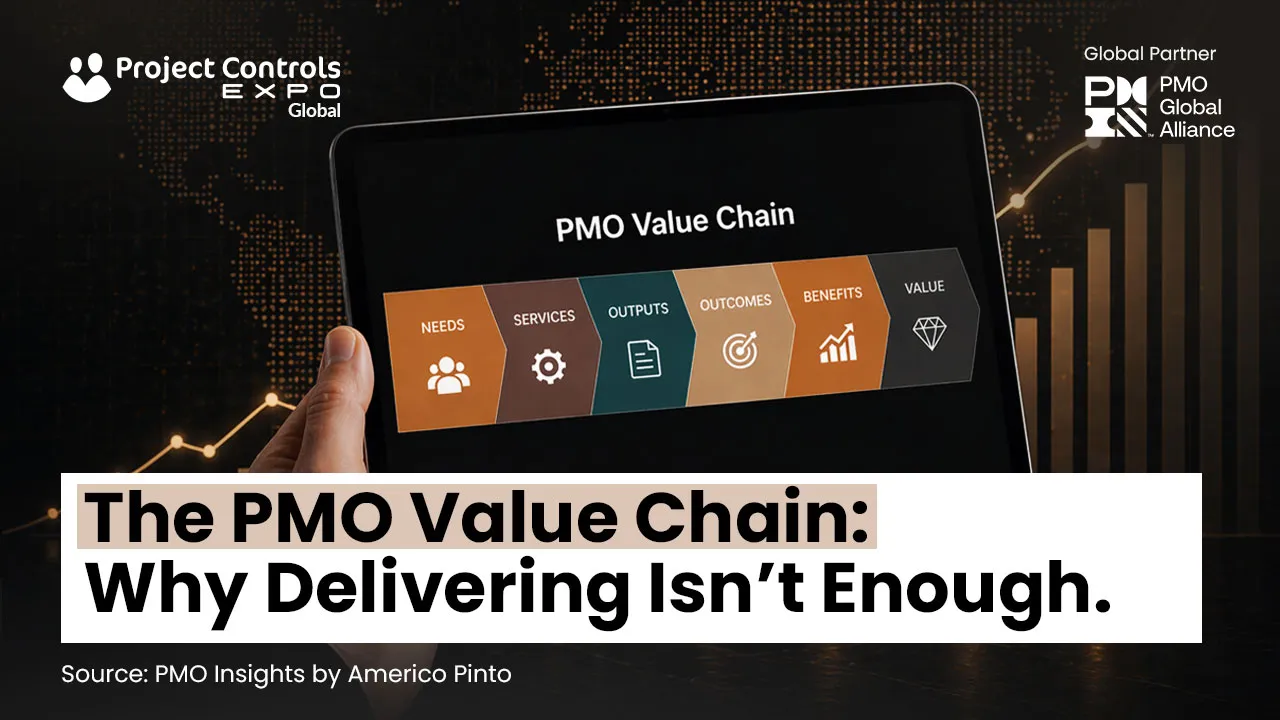
The PMO Value Chain: Why Delivering Isn’t Enough.
I've lost count of how many times I've heard this sentence from frustrated PMO leaders:
"We delivered everything they asked for, and they still don't see the value of our PMO."
Sound familiar That's because delivering isn't enough.
In a value-driven world, PMOs can no longer rely on outputs to prove relevance. The real game-changer is understanding how value actually happens, and how your PMO contributes to it, not just in execution, but in the eyes of your customers.
It's time we talk about the PMO Value Chain.
Your PMO doesn't create value by what it delivers, but by what changes because of it, and whether those changes are recognized.
A report is an output. Better decisions because of that report That's an outcome. If someone believes it made their job easier or helped them achieve a goal, that's a benefit.
But unless those benefits are recognized across the organization, and trust in your PMO grows, no real value has been delivered.
Each of these steps sounds simple. But each hides a dangerous assumption:
You assume the PMO customer's needs are clear.
You assume the PMO services are properly aligned.
You assume that because something was delivered, something must have changed.
You assume that the PMO customer recognizes that change as a benefit.
You assume that if someone benefited, the PMO's value is obvious for the organization.
Value isn't built on assumptions. It's built on alignment, perception, and trust.
This is why the PMO Value Chain was created: a structured model based on the PMI PMO Practice Guide. It's also directly connected to the Value-Generating PMO Flywheel, one of the key elements of the PMO Value Ring™ Framework, the heart of the guide.
The PMO Value Chain is a structured model that describes a progressive, interconnected journey from PMO customer needs to recognized organizational value. It shows how PMOs build relevance, impact, and trust over time.
It includes six key elements:
The explicit and implicit expectations of PMO customers.
Targeted responses tailored to address those needs.
Tangible deliverables provided through PMO services.
Observable changes resulting from those deliverables.
The perceived gains experienced by PMO customers.
The broader organizational recognition of those benefits, amplified by trust.
Let's take a closer look at the transitions in the PMO Value Chain and the Critical Success Factors that enable each one.
PMO Services only create value when aligned to real customer needs. Without this, the PMO risks delivering services that solve the wrong problems, or none at all.
The services provided by the PMO must be sufficiently mature to ensure high-quality outputs, which in turn increases the likelihood of achieving meaningful outcomes.
Even the best outputs lead nowhere if the PMO customer doesn't know what to do with them.
Benefits live in the mind of the PMO customer. In low-maturity environments, they may not be seen, appreciated, or even noticed.
Value happens when individual benefits accumulate into a shared organizational belief in the PMO's relevance.
Reflecting on a recent conversation with the PMO leader of a large financial services company, I clearly saw a break in their PMO Value Chain. Let me show you what happened:
The organization was struggling to connect its project portfolio with strategic goals. Executives lacked visibility and couldn't rely on project data to make decisions.
Executives needed clear visibility into how projects aligned with strategy to support informed decision-making.
The PMO developed a strategic portfolio management service with dashboards and governance routines.
Dashboards were delivered, detailed, accurate, and visually rich.
The dashboards weren't adopted. Their complexity, lack of integration, and lack of training blocked usage.
Executives didn't feel more empowered. No decision-making improvement was perceived.
Trust declined. The PMO's role was questioned. The chain had broken.
This is what happens when a single link in the PMO Value Chain breaks.
The needs were clear, the services were well chosen, and the output was delivered with quality. However, the outcome didn't materialize, so the benefit never emerged, and the organization's perception of the PMO's value and trust declined.
Are your customers connecting what your PMO delivers to what they care about Do your PMO services start with what they truly need Do outcomes turn into benefits in their eyes Do those benefits, over time, lead to trust
If not, it's time to rethink your PMO Value Chain.
Because value is not a milestone; it's a journey. And that journey doesn't begin with delivery. It begins with understanding. It doesn't end with output. It ends with recognition and trust.
Where does your PMO shine or struggle along the Value Chain Which link needs the most attention in your context
Drop your thoughts in the comments! Let's learn from each other!
Explore the new PMI PMO Practice Guide, available at www.pmi.org. Free for PMI members.
Learn how to turn insight into action with the PMO Value Ring™ Framework, the core of PMI's approach to value-driven PMOs.
Discover the PMI-PMOCP Certification, the gold standard for professionals who understand what value really means.
Join the PMOGA Online Community to go deeper with your peers: www.pmoga.pmi.org
In the next editions of the PMO Insights Newsletter, I'll dive deep into each element of the PMO Value Chain: Needs, Services, Outputs, Outcomes, Benefits, and Value. I'll explore how each connects to the Value-Generating PMO Flywheel, the centerpiece of the new PMO Value Ring™ Framework, and the heart of the new PMI PMO Practice Guide. Stay tuned!
Australia


