
Melbourne Cricket Ground
23-25 November 2026
 Australia
Australia
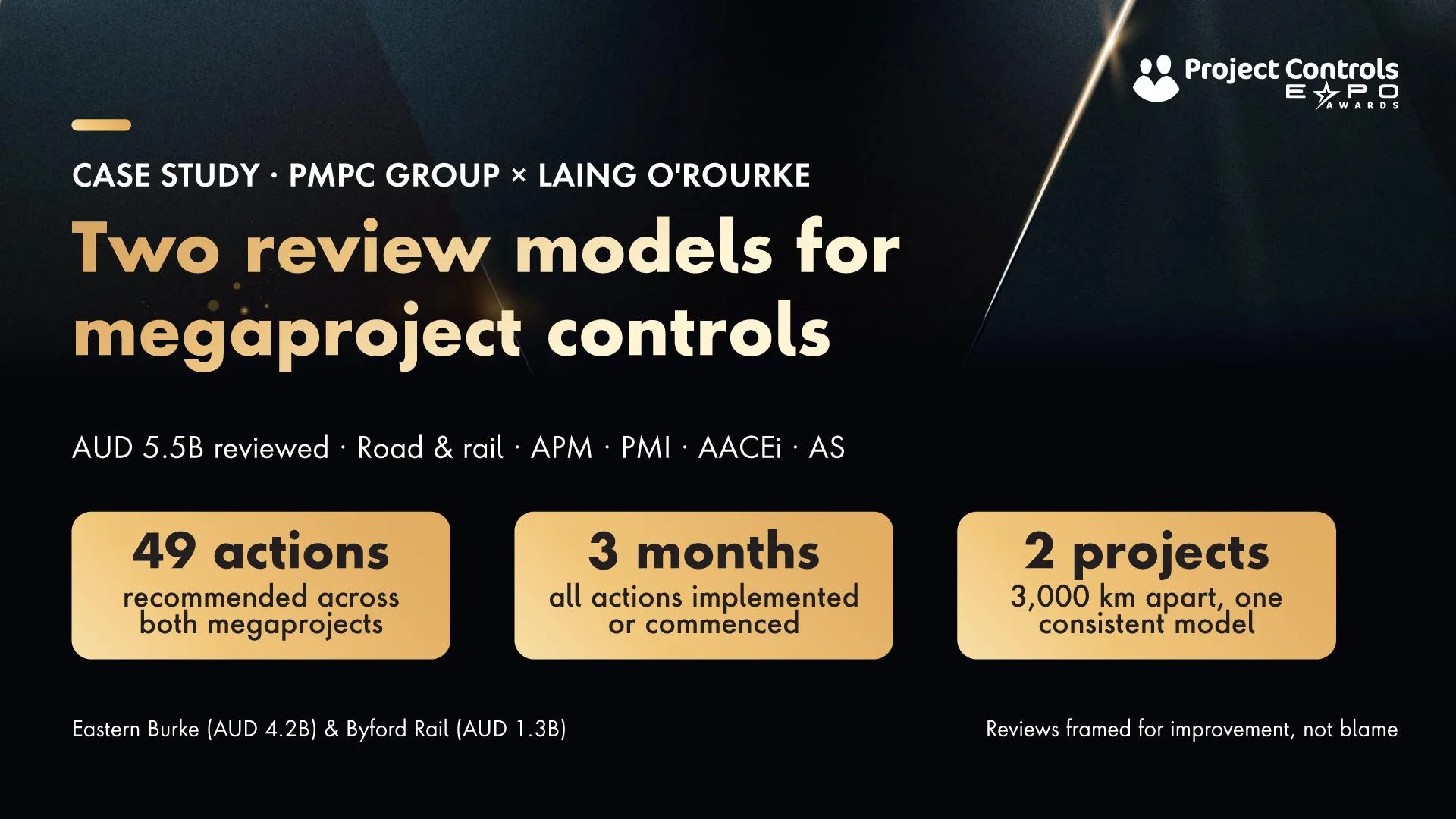
Two Innovative Review Models for Megaproject Controls: The PMPC Group Approach Applied to Laing O'Rourke's Eastern Burke to Tram Road Alliance and Byford Rail Extension
This paper documents two proprietary models developed by PMPC Group and applied to independent reviews of two Laing O'Rourke megaprojects: the Eastern Burke to Tram Road Alliance (AUD 4.2 billion, Melbourne) and the Byford Rail Extension (AUD 1.3 billion, Perth). The Project Review Model assesses process and system maturity across 21 discipline categories containing 54 subcategories, anchored in 49 industry reference documents from APM, PMI, AACEi, and Australian Standards. The Performance Model captures 31 individual performance metrics for the active reporting period. Forty-nine key recommended actions were issued across the two projects, with all either implemented or commenced within three months of the review. The paper documents the methodology, the comparative analysis between the two projects, the challenges encountered in conducting reviews in live megaproject environments, and the implications for the wider profession.
Megaproject review, project controls maturity, performance metrics, project review model, theoretical-practical integration, comparative analysis
Independent project reviews are a standard mechanism for assuring the controlled delivery of megaprojects, but the models used to conduct them vary widely in rigour and theoretical anchoring. Existing maturity models — including CMMI, P2MM, PMMM, P3M3, OPM3, and the Project Excellence Model — typically derive from a single body of knowledge and are oriented to organisational rather than project-specific assessment.
PMPC Group was engaged by Laing O'Rourke Australia to review two megaprojects: the Eastern Burke to Tram Road Alliance (AUD 4.2 billion) in Melbourne and the Byford Rail Extension (AUD 1.3 billion) in Perth. To deliver these reviews, PMPC Group developed two proprietary models that combine theoretical foundations from multiple bodies of knowledge with a practical, evidence-based assessment lens.
This paper describes the models, their application to two specific projects, the comparative analysis enabled by using a consistent model across both engagements, and the implications for the wider review and assurance practice in the megaproject community.
The Project Review Model assesses process and system maturity. Twenty-one discipline categories are available, decomposed into 54 subcategories. Each subcategory is assessed against a Review Analysis Criteria Guide that yields one of six determinations — Insufficient, Partial, Varying, Evident, Controlled, or Optimising — with a corresponding rating of 0 to 5. The model is supported by 49 industry reference documents drawn from APM, PMI, AACEi, and Australian Standards, and prompts the reviewer for up to 177 documents, artefacts, and methods that may support enhancement.
The Performance Model uses 31 individual metrics to assess the project's performance during a selected reporting period. The model supports core fundamentals including earned value analysis, burn-up charts, burn-down charts, combined burn charts, and resource utilisation.
The 49 reference documents underpinning the Project Review Model are drawn from four principal sources: the Association for Project Management (APM Body of Knowledge and selected APM guides), the Project Management Institute (PMBOK Guide, Practice Standards, and the PMI Standard for Earned Value Management), AACE International (Recommended Practices and the Total Cost Management Framework), and Australian Standards. Drawing on multiple sources allows the model to capture areas of consensus across bodies of knowledge while preserving the distinctive emphasis of each.
Each line of enquiry in the model is mapped to one or more reference documents. This mapping serves two purposes. First, it provides reviewers with a defensible basis for their assessment. Second, it provides the reviewed project with a pathway to improvement: the reference document associated with a low-scoring line of enquiry indicates where to look for established practice.
Each review proceeded through three phases. Phase 1 covered project familiarisation, document review, and model preparation. Phase 2 covered the project review itself, including interviews, meetings, model data inputs, and artefact evidence reviews. Phase 3 covered data analysis, report and presentation preparation, and submission.
Thirty-minute interviews were conducted with selected roles to establish the current state. Relevant system access was provided either directly or through visual demonstration. The Project Review Model was completed after the workshops and interviews, drawing on workshop notes, meeting outputs, and independent analysis. The Performance Model was completed using data from the January 2025 reporting period.
On the Eastern Burke to Tram Road Alliance the model generated 389 lines of enquiry; on the Byford Rail Extension it generated 356 lines of enquiry across the eight selected categories. Each line of enquiry had a corresponding industry reference for best practice.
A core deliverable was the comparative analysis between the two projects, identifying good practices that could be incorporated into the broader Laing O'Rourke organisation. Categories were standardised across both reviews to enable direct comparison, although Estimating and Design Cost Control were excluded from the Byford review on the basis that the project was less than a year from completion.
Approximately 40 people were interviewed across the two projects, with a total of 304 questions asked. Outputs included observations of good practice, 50 key recommended actions, 32 key review topics, 20 key themes, category-by-category comparison, and Review and Performance Model results.
Several patterns of difference between the two projects emerged from the comparison. The Eastern Burke to Tram Road Alliance, in earlier project lifecycle stage, showed stronger maturity in estimating and design cost planning. The Byford Rail Extension, closer to completion, showed stronger maturity in change management and reporting against baseline. These patterns are consistent with the natural maturation of project controls capability through the project lifecycle, and informed the recommendations issued to each project.
Live megaproject environments are fluid, and securing access to project resources — especially executives — was the principal practical challenge. Standard documentation was sometimes incomplete, and identifying the location, status, and comprehensiveness of evidence sources was time-consuming.
Data security and confidentiality were also significant. Non-disclosure agreements were executed before the commencement of the reviews, and where further discretion was required the team observed screenshots or had a suitable project staff member walk through the relevant system rather than receiving direct access.
Stakeholder anxiety about being reviewed was managed through engagement. A Terms of Reference was issued before commencement, covering purpose, scope, resourcing, timing, methodology, workshop and interview requirements, and progress reporting. The review was explicitly framed as an efficiency-based exercise rather than a finger-pointing one.
Forty-nine key recommended actions were issued across the two reviews, all of which were either implemented or commenced within three months. The Managing Director and executive team of Laing O'Rourke supported the implementation of each action. Improvements ranged from process documentation revisions through to targeted training and technology enhancements.
Feedback collected via post-review surveys was strongly positive. The most repeated requests were for longer notification and preparation periods before future reviews and for the review process to be extended to other projects within the organisation, in order to capture best practice and share lessons learned across a wider population of megaprojects.
The principal implication for the profession is that megaproject reviews benefit from drawing on multiple theoretical reference sources rather than a single body of knowledge. The combination of APM, PMI, AACEi, and Australian Standards in the Project Review Model produced a richer assessment than would have been achievable from any single source.
A second implication is that running multiple reviews using a consistent model generates comparative data of benchmarking value. The opportunity to compare project controls performance across road, rail, and other megaproject categories is one that the profession has not yet systematically exploited.
A third implication concerns the framing of reviews. The transformation of review perception from a finger-pointing exercise to a proactive enhancement approach was, in the team's view, as significant as the methodological contribution. Reviews that arrive with the Terms of Reference explicit about efficiency and improvement (rather than blame) produce more candid stakeholder participation and therefore more useful evidence. This framing principle is itself a transferable contribution.
The two models developed by PMPC Group, anchored in theoretical knowledge from multiple bodies of knowledge and applied through a practical lens, represent a contribution to megaproject review practice. The application of the same models to two megaprojects 3,000 kilometres apart, in different states, in different transport modes (road and rail), and with different client organisations, demonstrates the models' transferability.
PMPC Group has published a document titled 'PMPC Group Project Review — Application and Benefits' which is available on request and is intended for release on the PMPC Group website during 2025.
PMPC Group plans to apply the models to additional projects, building a comparative data set that will support benchmarking across megaproject categories. As the data set grows, it becomes possible to identify the practices that consistently distinguish higher-performing projects from comparable peers, providing a more empirically grounded basis for review recommendations than is currently available to the profession.
The authors acknowledge the contribution of Laing O'Rourke Australia, particularly the leadership and project teams of the Eastern Burke to Tram Road Alliance and the Byford Rail Extension. The willingness of the project teams to participate openly in interviews, workshops, and document reviews enabled the reviews to draw on candid evidence rather than curated reports. The Managing Director and executive team of Laing O'Rourke supported the implementation of the resulting recommendations across both projects within a three-month window.
[1] Project Management Institute. PMBOK Guide, Seventh Edition.
[2] Association for Project Management. APM Body of Knowledge, Seventh Edition.
[3] AACE International. Recommended Practices and Total Cost Management Framework.
[4] Standards Australia. Project Management Standards Series.
[5] PMPC Group (2025). Project Review — Application and Benefits, internal publication.
Australia


