
Melbourne Cricket Ground
23-25 November 2026
 Australia
Australia
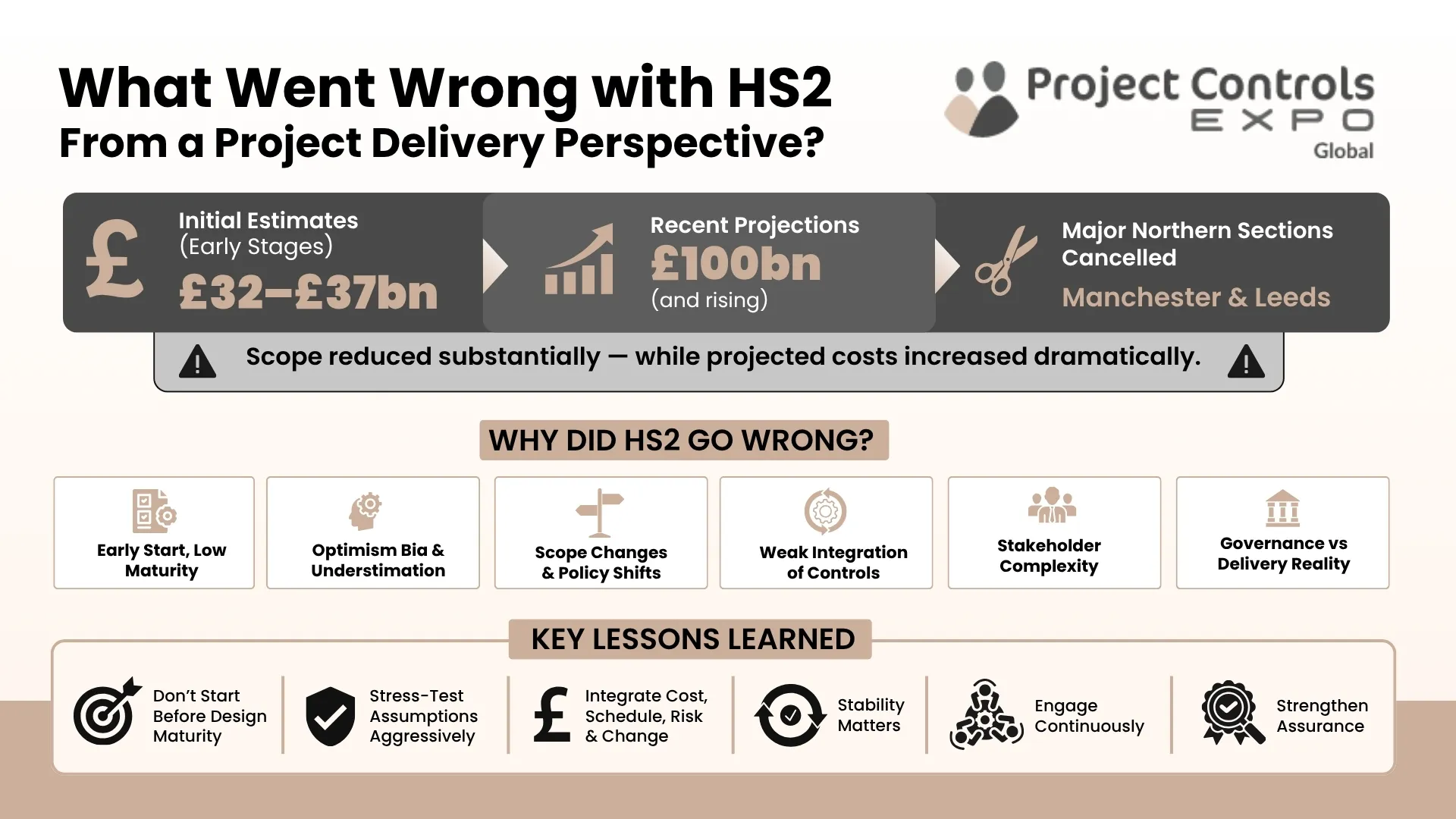
What Went Wrong With HS2 From a Project Delivery Perspective?
Few projects in modern UK history have generated as much debate as High Speed 2 (HS2).
Originally positioned as a transformational national infrastructure programme, HS2 has since become a case study in:
What makes this particularly significant is that:
The project’s scope reduced substantially — while projected costs increased dramatically.
Initial estimates in the early stages were around £32–37bn, yet more recent projections suggest costs could exceed £100bn, while major northern sections to Manchester and Leeds were cancelled. (Reuters)
So what actually went wrong?
One of the recurring themes across public reviews is that the programme was pushed into delivery before the scope and design were sufficiently mature.
The Stewart Review and subsequent commentary highlighted:
Even HS2 leadership later acknowledged a “rush to start” before adequate planning and cost certainty existed. (The Guardian)
This is a classic megaproject issue:
The desire to demonstrate momentum overtook delivery readiness.
HS2 also appears to demonstrate the long-recognised issue of:
Multiple public reviews noted that:
The NAO had already raised concerns years earlier around increasing compensation costs, station costs, and declining contingency resilience. (National Audit Office (NAO))
This reflects a wider challenge seen globally across megaprojects:
Projects are often approved based on affordability assumptions rather than delivery reality.
Another major issue was continuous change:
The programme experienced repeated political and policy shifts across administrations. (GOV.UK)
This created:
One of the harsh realities in major programmes is:
Constant strategic change destroys delivery stability.
Public reports repeatedly pointed to:
The Stewart Review highlighted that:
This is fundamentally a Project Controls issue.
When:
are not fully integrated, organisations lose the ability to:
HS2 was never just an engineering project.
It involved:
Stakeholder management became extraordinarily complex, particularly around:
In megaprojects, stakeholder alignment is not a “soft issue”:
It is a delivery-critical discipline.
One of the strongest observations from parliamentary and public reviews is the gap between:
The Public Accounts Committee described failures in:
This highlights an uncomfortable truth:
Governance does not guarantee control.
Complex projects require:
Key Lessons Learned (LLs)
Political urgency should never override delivery readiness.
A credible estimate is not the same as an affordable estimate.
Fragmented controls create fragmented decisions.
Constant policy and scope shifts destroy delivery efficiency.
Buy-in is not achieved once — it must be maintained throughout the lifecycle.
Particularly where public money is involved.
Bodies such as National Infrastructure and Service Transformation Authority (NISTA/IPA) are making efforts to strengthen governance and assurance frameworks in the UK, but HS2 demonstrates that:
Megaproject oversight still requires stronger integration between governance, controls, and delivery execution.
HS2 should not simply be viewed as a “failed railway project.”
It should be viewed as:
One of the most important project delivery case studies of modern times.
Because the core issues are not unique to rail.
They are the same themes repeatedly seen across global megaprojects:
The challenge now is not simply to criticise HS2.
The challenge is:
How do we ensure future megaprojects do not repeat the same mistakes?
Disclaimer: The views expressed in this article are purely my personal and professional reflections based on information available in the public domain, including credible media reports, parliamentary publications, and industry commentary. The intent of this article is not to criticise, blame, or offend any individual, organisation, or institution involved in HS2, but rather to encourage constructive discussion around project delivery, governance, lessons learned, and how we can collectively improve the successful delivery of future major programmes.
Sources
https://www.reuters.com/business/cost-uks-hs2-rail-project-soars-138-billion-minister-says-2026-05-19
https://www.theguardian.com/business/2026/may/19/hs2-bill-could-rise-102bn-pounds-first-trains-delayed-until-2039-government-admits?
https://www.instituteforgovernment.org.uk/explainer/hs2-costs?
https://www.theguardian.com/uk-news/2024/dec/19/hs2-mark-wild-costs-budget-department-transport?
https://assets.publishing.service.gov.uk/media/68a72b319e1cebdd2c96a0ae/hs2-experience-major-transport-projects-governance-assurance-review.pdf?
https://www.nao.org.uk/wp-content/uploads/2016/06/Progress-with-preparations-for-High-Speed-2.pdf?
https://www.gov.uk/government/speeches/hs2-6-monthly-report-to-parliament-july-2025?
https://www.gov.uk/government/speeches/hs2-6-monthly-report-to-parliament-july-2025?
https://www.theguardian.com/uk-news/2025/jun/18/hs2-delayed-beyond-2033-high-speed-rail?
https://publications.parliament.uk/pa/cm5901/cmselect/cmpubacc/357/report.html?
https://www.ft.com/content/591a5746-f4ac-43f5-b94b-5fc287525cc7?
https://www.productivity.ac.uk/wp-content/uploads/2025/02/PIP052-What-went-wrong-with-HS2-February-2025.pdf?
https://www.nao.org.uk/wp-content/uploads/2024/07/hs2-update-following-cancellation-of-phase-2.pdf?
https://www.productivity.ac.uk/wp-content/uploads/2025/02/PIP052-What-went-wrong-with-HS2-February-2025.pdf?
https://www.instituteforgovernment.org.uk/explainer/hs2-costs?
Australia


