
Wembley Stadium, London
2-4 November 2026
 United Kingdom
United Kingdom
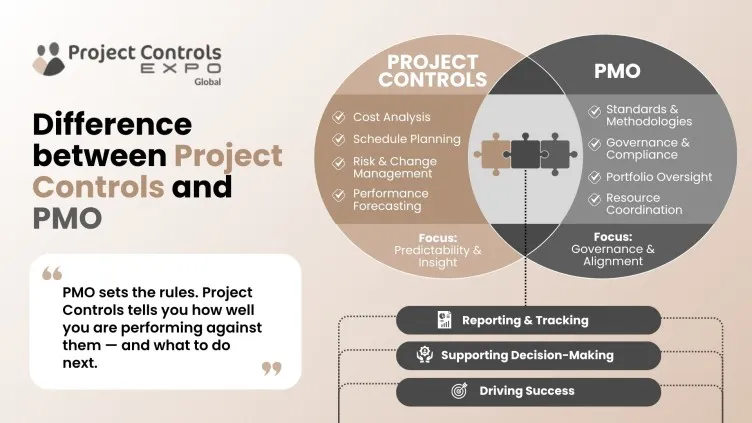
Project Controls vs PMO — Understanding the Difference (and Why It Matters)
Project Controls and PMO are often used interchangeably — but they are fundamentally different.
This confusion leads to blurred responsibilities, inefficiencies, and missed opportunities to improve project outcomes.
Let's define both properly.
According to the Association for Project Management (APM) Body of Knowledge:
"A project, programme or portfolio management office (PMO) is an organisational structure that provides support to projects. The PMO may be a project management office, programme management office or portfolio management office, depending on what is being supported."
It further highlights that a PMO delivers three key benefits:
In practice, the PMO acts as the governance and coordination function, focusing on:
The PMO creates the structure within which projects operate.
Project Controls can be defined as:
A scientific, data-driven sub-function of project management that ensures the right information is provided to the right stakeholders at the right time — enabling informed decision-making and successful delivery of complex projects.
It focuses on:
It answers three critical questions:
Where are we today?
Where are we heading?
What should we do about it?
Project Controls is the analytical engine that drives predictability, transparency, and control.
In simple terms: PMO sets the rules. Project Controls tells you how well you are performing against them — and what to do next.
In theory, both functions should complement each other.
In practice, many organisations operate with only one.
In sectors such as Construction, Infrastructure, Energy (especially oil & gas), and Defence and aerospace, the dominant function is Project Controls, often referred to as "Project Services" (particularly in EPCs and among operators in oil & gas).
These environments prioritise:
PMO structures are often less prominent or embedded differently.
In contrast, industries such as IT and software delivery, digital transformation, financial services, and consulting tend to rely heavily on PMOs.
These environments prioritise:
Project Controls capabilities may exist, but are often less formalised.
Adoption also varies globally:
Strong Project Controls in infrastructure; mature PMO in corporate environments
Heavy reliance on Project Controls due to megaprojects
Balanced mix of PMO and Project Controls
Project Controls-led in infrastructure and mining
There are areas where both functions intersect:
However, both functions risk becoming reporting-heavy rather than decision-focused.
The issue is not choosing between PMO and Project Controls.
The real challenges are:
Unclear roles and responsibilities
Duplication or capability gaps
Fragmented data and inconsistent processes
Overemphasis on reporting rather than decision-making
As complexity increases and AI-enabled delivery emerges:
Strategy, governance, and value realisation
Decision intelligence and predictive capability
But one principle remains critical:
Governance and insight are not the same — but both are essential.
If your organisation is still debating PMO vs Project Controls, you may be asking the wrong question.
The better question is:
How do we align governance and insight to enable better decisions?
Because ultimately:
Projects don't fail due to lack of reporting — they fail due to lack of timely, informed decisions.
United Kingdom


