
Wembley Stadium, London
2-4 November 2026
 United Kingdom
United Kingdom
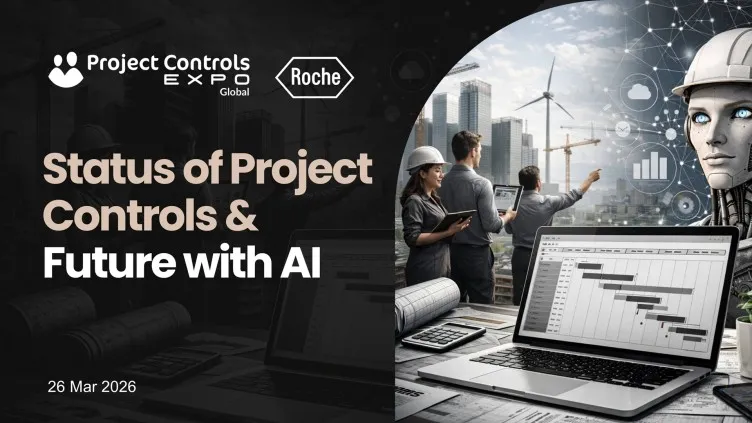
Status of Project Controls & The Future with AI
Today, I had the opportunity to deliver a session to Roche Diagnostics, sharing a holistic view on the current state of Project Controls and its future in an AI-enabled world.
The discussion reinforced a simple but powerful reality:
Project Controls is no longer just a reporting function — it is a strategic enabler of delivery certainty.
At its core, Project Controls is about:
Providing the right information, to the right stakeholders, at the right time — to enable the right decisions.
It brings together planning, cost, risk, change, and performance management into a structured framework that ensures:
In increasingly complex environments — such as pharma, infrastructure, and energy — this capability is not optional. It is fundamental to successful project delivery.
The growing importance of Project Controls is not accidental. It is driven by:
Organisations are no longer asking "Do we need Project Controls?" They are asking: "How mature and effective is our Project Controls capability?"
Project Controls has evolved significantly:
Siloed reporting functions
Integrated performance management
Decision intelligence capability
We are moving from descriptive reporting to predictive and prescriptive insight — a shift that is redefining expectations from the function.
There have been meaningful efforts globally to formalise Project Controls through:
However, challenges remain:
Standardisation is improving — but we are still on the journey.
AI is often positioned as a disruptor. In reality, it is better understood as an accelerator.
At a fundamental level:
AI's relevance to Project Controls lies in its ability to:
Automate data collection and structuring
Enhance data integration across systems
Enable faster insight generation and reporting
Improve decision support through scenario analysis
However, one principle remains unchanged:
"Garbage in, garbage out."
Without clean, structured, and integrated data, AI will simply amplify noise.
As the discipline evolves, so must the skillset.
Future Project Controls professionals will need to combine:
Strong quantitative capability (core discipline)
Data literacy and digital fluency
Ability to interpret and challenge AI outputs
Commercial and strategic thinking
Stakeholder engagement and communication
The role is shifting from analyst → advisor → decision enabler.
The future of Project Controls is not Human vs AI. It is Human + AI.
Together, they create a capability that is: More informed, more proactive, and more impactful.
The session with Roche Diagnostics highlighted that organisations are ready to embrace this shift — but success will depend on getting the fundamentals right:
Project Controls has always been about enabling better decisions.
With AI, we now have the opportunity to do this faster, deeper, and at scale.
The question is no longer if this transformation will happen — but how effectively we prepare for it.
United Kingdom


