
Wembley Stadium, London
2-4 November 2026
 United Kingdom
United Kingdom
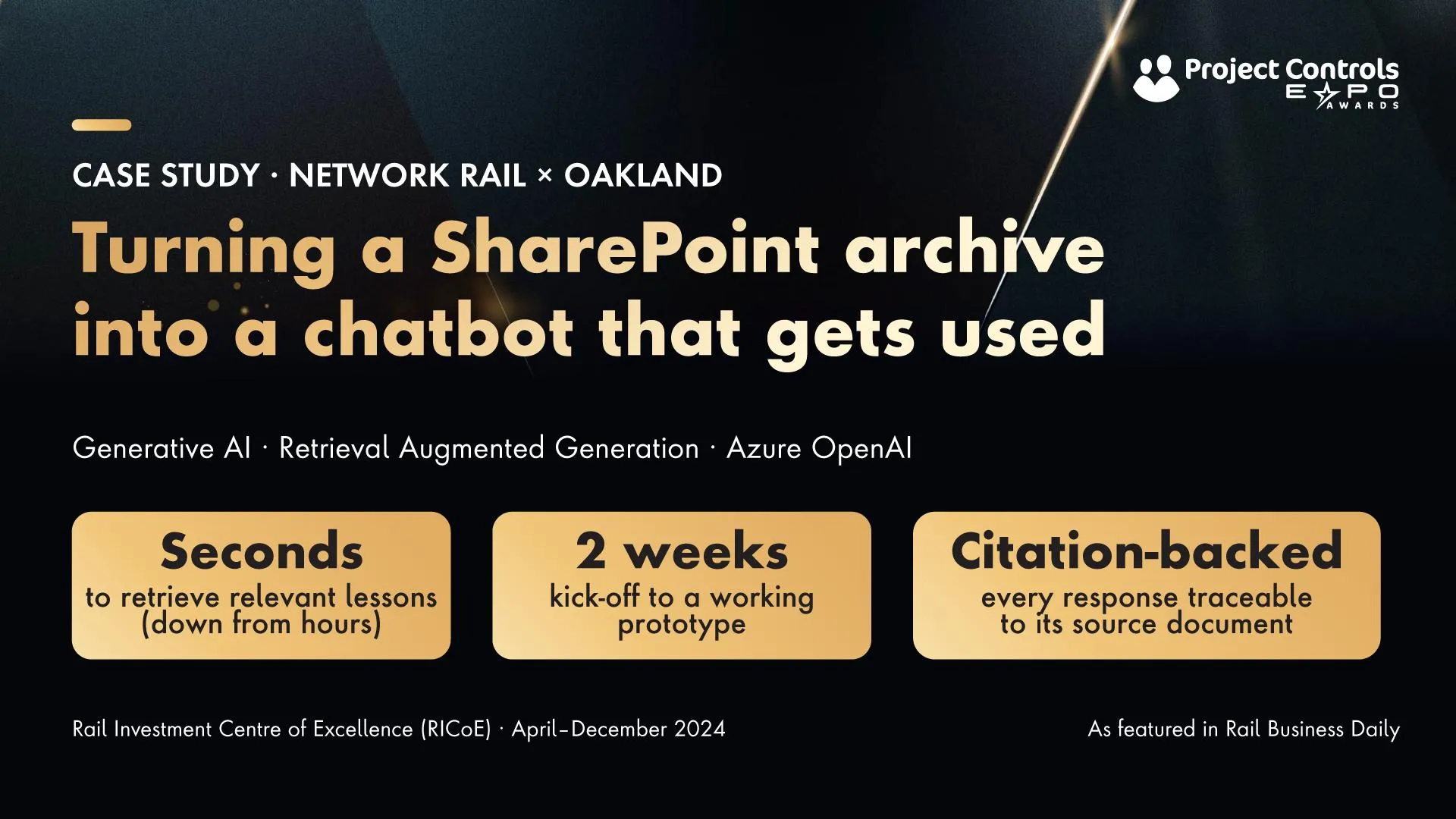
Turning a SharePoint resource into a chatbot that actually gets used
Network Rail and Oakland rebuilt institutional knowledge as a working tool
Network Rail had years of lessons learned from capital delivery projects sitting in SharePoint. The data was real, the value was real, the access wasn't always seamless. Different formats, mixed media types (PDFs, slide decks, videos, lists), and the sheer volume meant that the people most likely to benefit from past lessons — engineers and project teams about to repeat them — sometimes found it difficult to find them.
This is a familiar story in large organisations. Knowledge management has long been a discipline of capture rather than retrieval. RICoE wanted to change that — to make sure lessons were actually learned, not just archived.
Network Rail and Oakland delivered a Generative AI chatbot using Retrieval Augmented Generation (RAG), built on Microsoft Azure's OpenAI services. The pipeline extracts lesson data from SharePoint, processes it into searchable text, indexes it with Azure AI Search, and serves answers through a chat interface that cites its sources back to the original document.
The technical architecture mattered, but the delivery model mattered more. We worked in two-week agile sprints with regular demos and continuous feedback. A functional chatbot was live within two weeks. The Proof of Concept ran for four to five weeks. Phase 2 hardened the cloud infrastructure, security and deployment pipelines. Phase 3 deployed it into Network Rail's production Azure environment, aligned to IT governance.
Throughout, we treated transparency as a feature rather than a compliance item. Every answer the chatbot generates carries citations back to the source document — so users can verify what the AI is telling them and the organisation can audit how knowledge is being used.
The headline benefit is speed: project teams can ask natural-language questions like 'we are building a bridge, what should I know?' and get answers in seconds instead of hours of searching. But the deeper benefit is behavioural. When retrieval is friction-free, people actually consult past experience before making decisions — turning a passive archive into active decision support.
When retrieval is friction-free, people actually consult past experience before making decisions — turning a passive archive into active decision support.
Three things have travelled with us into other AI engagements:
The chatbot is only as good as the underlying content. Ongoing data governance and curation matter more than model selection.
Two-week sprints with real users beat any amount of upfront design. Trust is built incrementally, not declared.
Azure's AI services gave us a path that is secure, compliant, and easy to evolve as Network Rail's needs grow.
The case has been published in Rail Business Daily, and the architecture is being looked at as a template for other large infrastructure operators with similar dormant knowledge bases.
United Kingdom


