
Melbourne Cricket Ground
23-25 November 2026
 Australia
Australia
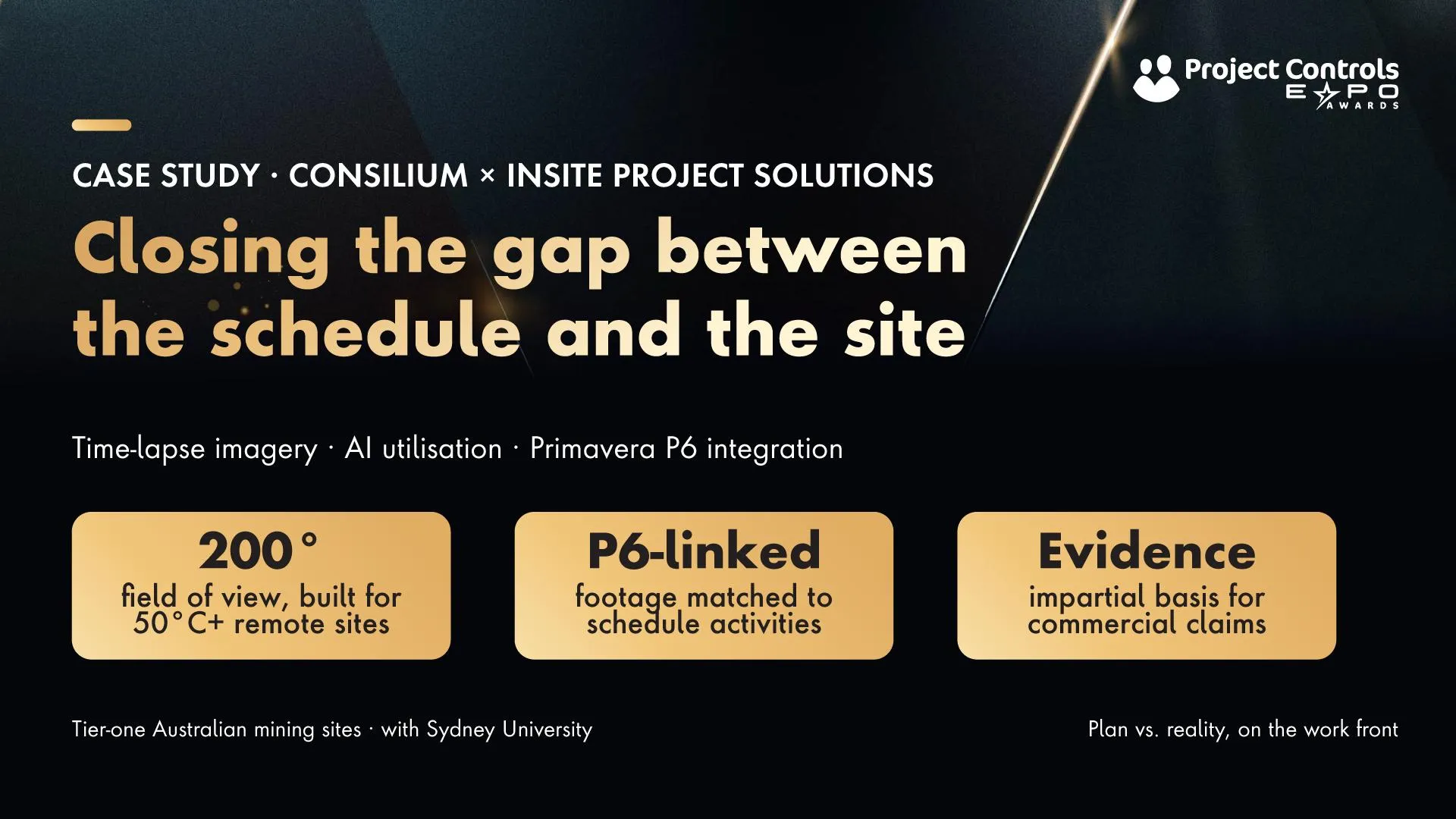
InSite Project Solutions Time-Lapse Imagery, AI, and P6 Schedule Integration for Real-Time Construction Verification
This paper describes the development of InSite Project Solutions, an integrated hardware-and-software system that links high-resolution time-lapse imagery to a Primavera P6 schedule and uses artificial intelligence to identify personnel and equipment utilisation. The objective is to replace traditional daily, weekly, and monthly reporting with an annotated video record that closes the gap between the schedule and on-site reality, and to provide an impartial evidentiary basis for commercial claims. The paper documents the hardware challenges encountered during deployment in remote Australian conditions, the schedule-XER integration architecture, the AI training approach using historical fault data, and the operational benefits observed during initial tier-one mining deployments. Trade-offs between off-the-shelf and purpose-built components are discussed.
Construction projects exhibit a persistent disconnect between the schedule and what physically occurs on site. Contractors and principals each rely on the schedule to communicate progress, often selectively, and commercial claims are typically justified using daily reports of uneven quality supplemented by photographs of limited evidentiary value. This pattern incurs administrative cost, increases disputes, and undermines the value of formal project controls.
InSite Project Solutions, developed by the consulting firm Consilium Solutions, addresses this gap by integrating smart cameras, time-lapse imagery, and artificial intelligence with the project schedule. The system records what actually occurs on the work front against what was planned, providing an impartial basis for both internal performance management and external commercial claims.
This paper documents the system's architecture, the iterative development process undertaken by Consilium Solutions, the field deployments that informed hardware iteration, and the implications for the project controls profession. Particular attention is given to the design choices that distinguish InSite from prior attempts to bring camera-based monitoring into the construction environment: the integration with the Primavera P6 schedule, the AI-driven utilisation analysis, and the climatic resilience required for remote Australian deployment.
The InSite system comprises three principal components: a ruggedised camera unit, a solar-powered telescopic skid, and a web portal that ingests both imagery and Primavera P6 schedule XER files.
The camera unit uses two high-resolution lenses stitched to produce approximately a 200-degree field of view. A custom housing provides airflow paths and thermal breaks to protect the processing unit from ambient temperatures exceeding 50°C. Imagery capture intervals are programmable and tuned to the specific construction activity being monitored.
The solar skid carries a 12-metre telescopic mast and provides primary network connectivity via Starlink with a secondary fallback to Telstra's 4G network. Battery capacity supports approximately ten days of autonomous operation without direct sunlight, enabling deployment in remote greenfield sites. The web portal ingests a Primavera P6 schedule XER. When a user selects a time window for video generation, the portal automatically retrieves the activities scheduled to occur during that window and presents them alongside the time-lapse footage. Users without P6 expertise can therefore validate works against the plan by viewing the video.
The XER ingestion workflow consists of four steps. First, the user uploads the latest Primavera P6 XER export to the InSite web portal. Second, the portal parses the XER and indexes the activity records by activity ID, start date, finish date, and work-breakdown-structure (WBS) path. Third, when the user selects a time window for video review, the portal queries the activity index for activities whose start or finish falls within that window. Fourth, the activities are presented in a side-panel alongside the time-lapse footage, allowing the user to confirm visually whether the planned activity occurred.
An event annotation capability allows the user to flag slips against specific activities and capture commentary directly in the portal. These annotations persist with the project record and can be exported to support claim documentation, schedule update narratives, and lessons-learned capture. The annotation mechanism is the principal pathway by which the visual record becomes structured project controls data.
Development was led by Consilium directors Christian Chandler and Shane Waldron, supported by an external software developer, Cian Byrne, with experience in artificial intelligence systems. A collaborative research partnership with Sydney University supported software development, AI tuning, and integration testing.
The team adopted a three-angle attack: project controls, project management, and software development. Each contributor focused on their strength, and each component was verified for practical field deployment. The initial commercial trials were conducted on tier-one mining sites where Consilium's consulting arm already had access, enabling fast iteration between trials and design changes.
Multiple existing camera and AI software products were evaluated before purpose-built hardware was selected. The decision to build was driven by the absence of off-the-shelf systems combining the climatic resilience, vantage requirements, AI integration, and schedule linkage needed for Australian remote construction.
Initial deployment was at the extension of an existing conveyor system within an iron-ore processing plant in north-western Australia. The vantage offered by the 12-metre mast captured the work front and the surrounding landscape, allowing project teams to observe major crane lifts in real time and supervisors to record video diaries for shift handovers in place of written reports.
Subsequent deployments revealed a recurring pattern: night-shift productivity typically reported as comparable to day shift was, on inspection of the footage, materially lower. The system allowed planners to challenge productivity assumptions with evidence and to modify forward plans based on observed reality.
Operational results to date include improvements in shift handovers, validation of subcontractor and contractor claims, improved planning for follow-on projects, and reduced reliance on fly-in/fly-out roles since multiple stakeholders can observe the work front remotely.
Several failure points emerged during early field deployments. Processing-unit heat generation in extreme ambient temperatures was the most persistent issue, addressed through revised housing geometry and the introduction of thermal breaks. Dust accumulation on lenses and solar panels was the second most significant issue, addressed through siting changes and revised maintenance intervals. A third issue concerned pinching and failure of joints and connections within the camera housing under thermal cycling, addressed through detailed design revision and red-line mark-ups.
Subject matter experts in industrial design were engaged for housing design, while software and web development specialists addressed the management of high-dust, high-temperature data flows. A hybrid local-cloud server architecture was adopted to manage the volume of imagery without overloading remote network links.
A second category of challenges concerned the management of large time-lapse video data sets. Continuous capture at high resolution generates volumes that exceed practical upload bandwidth on remote sites, even with Starlink. The system therefore performs local processing to compress and edit the imagery before upload, retaining the original raw frames on local storage for later retrieval if needed. This local-then-cloud architecture was the principal enabler of remote deployment.
Gantt charts have been the dominant project management instrument for more than a century, but the communication of Gantt charts to broader project teams, and the accurate capture of as-built data against them, remain weak. InSite addresses both gaps simultaneously: the time-lapse video makes the work visible to non-experts, and the integration with the P6 XER provides a structured way to capture commentary against specific activities and slips.
For the wider profession, the implication is that project controls innovations need not solve every problem at once. The system's design intentionally limits itself to one integration — video and schedule — and resists the more common ambition of integrating cost, schedule, and risk into a single platform. This narrower focus produced a working product more quickly than broader integration attempts typically achieve.
The system's use case extends beyond construction monitoring. Three additional applications have emerged from initial deployments. The first is shift-handover support, where outgoing supervisors record a brief annotated video tour of the work front rather than writing a handover report. The second is stakeholder communication, where remote executives, regulators, and customer representatives view the work front directly rather than relying on intermediated reporting. The third is marketing and project storytelling, where time-lapse compilations provide compelling evidence of project performance to investors and the public.
InSite Project Solutions demonstrates that focused integration of time-lapse imagery with the Primavera P6 schedule can transform construction project transparency. The combination of purpose-built hardware suitable for the Australian climate, AI-driven personnel and equipment identification, and direct XER ingestion provides an impartial basis for performance management and commercial claims that the existing tooling landscape has not previously offered.
Future work will focus on completing the replacement of weekly project reports with an integrated video diary and on extending the system to cover further dimensions of project performance.
The development is part of a broader trend in construction technology toward systems that close the loop between planning and execution. Several research and commercial efforts are underway to integrate sensors, imagery, and schedule data, but few have achieved field deployment on operational sites in the kinds of conditions encountered on Australian mining and infrastructure work. The InSite experience contributes both an existence proof — that such integration is feasible at field scale — and a documented set of design choices that other practitioners can reference.
The authors acknowledge the contribution of Sydney University's research partnership, which supported software development, AI tuning, and integration testing throughout the program. The tier-one mining clients whose sites hosted the initial commercial trials provided invaluable real-world feedback that shaped successive hardware iterations. External software developer Cian Byrne contributed AI systems expertise, and industrial design specialists supported the resolution of the thermal and dust challenges encountered during early deployments.
[1] Consilium Solutions (2025). InSite Project Solutions: Hardware and Software Specification, internal document.
[2] Oracle Corporation. Primavera P6 XER File Specification.
[3] Sydney University Research Partnership Agreement, InSite Software Development.
[4] Project Controls Expo Asia-Pacific 2025. Conference proceedings.
Australia


