
Melbourne Cricket Ground
23-25 November 2026
 Australia
Australia
Mentor-Led Development of a Project Management Framework for a Regional Council: The Gympie Regional Council Case
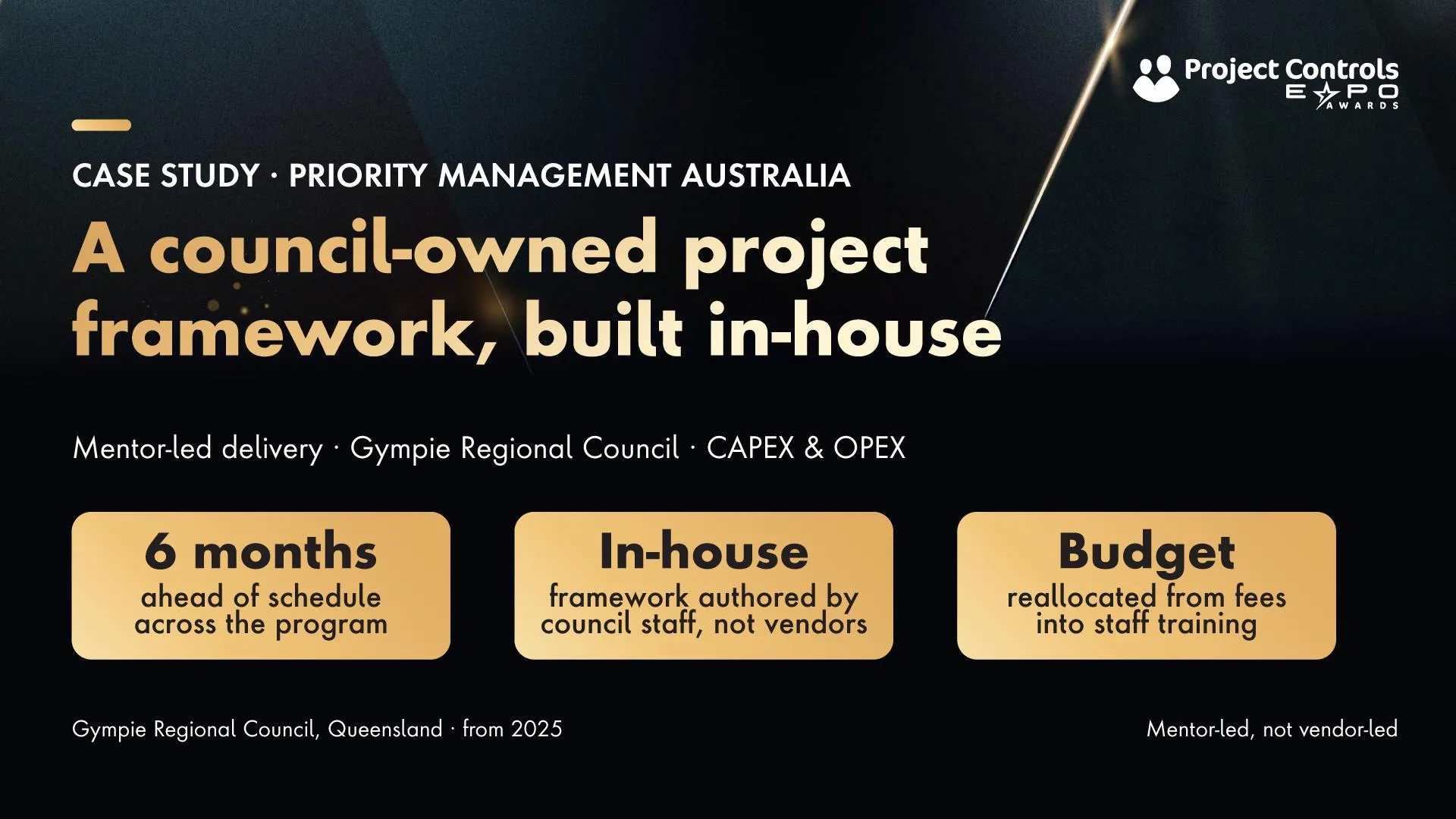
Regional councils often struggle to maintain a Project Management Framework (PMF) that is both rigorous and broadly understood by the staff who must use it. This paper describes how Priority Management Australia (PMA) supported Gympie Regional Council (GRC) to develop a council-owned PMF for both Capital Expenditure (CAPEX) and Operational Expenditure (OPEX) projects through a mentor-led, rather than vendor-led, model. The consultant acted as mentor to a Project Sponsor and Project Manager nominated from inside the council, while the framework itself was built by council staff. The result was a workable framework delivered four months ahead of schedule, internal upskilling, and reallocation of consultancy budget into staff training. The paper documents the mentoring model, the introduction of a two-part Project Management Plan (PMP), and lessons on stakeholder ownership of frameworks.
Project Management Framework, regional council, capital and operational expenditure, mentor-led consulting, RACI, project sponsor
Gympie Regional Council (GRC) is a Queensland local government area whose capital and operational projects had historically been managed through a Project Management Framework (PMF) that staff found convoluted and inconsistent. Repeated outsourcing of projects and turnover of senior project staff had produced successive versions of the framework, each imposed with limited input from the project workforce. The cumulative effect was a PMF that existed on paper but was not embedded in practice.
In April 2025 GRC's Director of Infrastructure approached Priority Management Australia (PMA) on the basis of PMA's earlier work building a PMF for Cairns Regional Council (CRC) in 2018. The brief was unusual in two respects: the council already had a PMF, and the senior project staff explicitly wanted the new framework to be designed by GRC employees rather than imposed by an external party.
This paper documents the methodology and outcomes of the engagement, focusing on three elements that distinguished it from conventional vendor-led PMF implementations. The first is the structure of the engagement as a mentor-led model in which council staff authored the framework. The second is the establishment and operation of a Project Management Reference Group with endorsement authority. The third is the introduction of a two-part Project Management Plan that relocated initiation responsibility to client departments.
PMA's engagement was structured as a mentor-led model. Wayne Greenwood, PMA's Managing Director, was engaged as mentor to the GRC Project Sponsor (Liam Watson) and the GRC Project Manager (Dennis Luinstra), with additional support to Project Officer Jade Lawler. The PMF itself was developed by GRC staff. PMA's role was confined to method, technique, and quality assurance.
A Project Management Reference Group (PMRG) was established as a project user group with representation from across council departments. The PMRG met fortnightly during the first three months of the engagement, monthly for the next six months, and on demand thereafter. The PMRG provided structured feedback on each stage of development and endorsed all framework changes before they progressed from testing into implementation.
PMA's diagnostic approach was applied at engagement commencement, structured around ten questions covering project purpose, expected benefits, current state, deliverables, internal and external resources, success measures, constraints, stakeholders, and reporting requirements. The principle underpinning this approach is that prescription without diagnosis is malpractice.
Stage 1 of the project was delivered against a 12-month schedule built in OverVue software, with detailed deliverable descriptions and identification of Subject Matter Experts (SMEs) for each deliverable. Each deliverable was decomposed into tasks with assigned resources, the schedule was shared with the PMRG, and council staff were given advance notice of tasks requiring their input.
A signature methodological choice was to require client departments — rather than the Project Management Office (PMO) — to complete Part A of a new Project Management Plan (PMP). PMP Part A captured expected benefits, project purpose, and indicative scope before the project was passed to the PMO. PMP Part B was then completed by the PMO once a project was approved through the budget review and assigned a finance code.
Position descriptions were developed for Program Manager, Senior Project Managers, Project Managers, Project Supervisors, Project Officers, and Project Administrators. A RACI matrix was developed for the framework project itself and subsequently became a template for project RACI matrices within the PMF. Existing staff were mapped against the new descriptions, contracted external project managers were considered for permanent employment, and career progression pathways were defined to allow operational staff to transition into project roles.
The Project Management Reference Group (PMRG) was the principal governance instrument used to convert subject matter expertise into framework decisions. The PMRG had endorsement authority over every change before it transitioned from testing to implementation. Membership included representation from each council department whose work would be affected by the new PMF, with rotating chair responsibilities and a written terms of reference.
Meeting cadence was tuned to the project's evolving needs. Fortnightly meetings during the first three months ensured rapid feedback on early framework drafts. Monthly cadence during months four to nine matched the slower review cycle of implementation. On-demand meetings thereafter reflected the framework's stability. Reports were circulated even when meetings were not scheduled, ensuring that the PMRG remained engaged as a body of record even when its formal decision rhythm slowed.
The schedule built in OverVue was exported via CSV into Smartsheet, where individual tasks were tracked. Collated data was transferred to the council's existing finance software. This pattern allowed Smartsheet to function as the PMO's project register, exposing each project to a single dashboard while preserving integration with the corporate finance system.
PMP Part A produced a downstream benefit unrelated to the original brief: by capturing forward-looking project information at the request stage, it gave the Director of Engineering a multi-year view of likely future projects. In February 2024 the annual CAPEX budget was prepared in record time, allowing the Finance Department additional time to apply for Commonwealth and State funding grants.
The choice of OverVue for the master schedule and Smartsheet as the task and reporting system was deliberate. OverVue's high-level view supported communication with non-specialist stakeholders, including the Executive Leadership Team and elected councillors. Smartsheet provided sufficient granularity for the project office to track tasks, while exposing the same data to the finance system without bespoke integration. The combination avoided the cost and time of implementing a single integrated tool while still producing a single source of truth for the PMF project.
Stage 1 of the PMF project was completed four months ahead of schedule. Training of all council project staff was brought forward by four months, allowing Stage 2 (incorporation of OPEX projects into the PMF) to begin earlier than planned. Overall the project ran approximately six months ahead of schedule, and money originally identified for consultancy fees was reallocated to staff training in project management.
Project documentation across CAPEX and OPEX is now compliant with current legislation and Australian Quality Standards. Client departments can access their proposed and ongoing projects to build realistic budgets quickly. The Finance Department has secured increased grant funding using the improved scoping, design, and approval documentation.
Several council staff who had not previously considered project management as a career were identified as candidates for development into project roles. Staff turnover in the PMO has reduced, and morale within the project workforce has improved. The Executive Leadership Team now has multi-year visibility of CAPEX and OPEX programs.
An indirect outcome was the strengthening of the Finance Department's grant application capability. By identifying CAPEX projects 12 to 36 months ahead of commencement, the council enabled Finance to prepare more rigorous Commonwealth and State grant applications. The improved scope, design, and approval documentation produced through the PMF process directly reduced the rework and resubmission cycles that had historically constrained the council's grant success rate.
The most transferable lesson concerns ownership. Where prior PMFs had been imposed on the workforce, the GRC framework was authored by the workforce and mentored by the consultant. The shift in ownership produced higher adherence and faster adoption than either party had originally projected.
A second lesson concerned scheduling and SME engagement. A resource-loaded schedule was shared with SMEs before being baselined, giving them advance notice of upcoming tasks. This single practice was identified by PMA as the biggest single lesson learned from the engagement, since it allowed SMEs to prepare for their assigned tasks and prevented the bottlenecks that typically affect resource-constrained councils.
A residual issue arose when the IT representative on the PMRG informally shared in-flight information with the IT department, with the result that several IT projects bypassed the PMF process and subsequently had to be resubmitted. The lesson is that communication discipline within a reference group matters as much as the framework itself.
The Gympie Regional Council PMF engagement demonstrates that a mentor-led consulting model can deliver a robust, council-owned framework in less time than a traditional vendor-led approach. The key enablers were a Project Management Reference Group with genuine endorsement authority, a two-part PMP that pushed initiation responsibility onto client departments, and a resource-loaded schedule shared with SMEs ahead of baselining.
The framework now anchors all CAPEX and OPEX projects at GRC, including a multi-year visibility horizon for the Executive Leadership Team, an enabler of larger and more complex program planning. The community benefit is observed in upgraded infrastructure, clearer development timelines, and increased local economic activity.
Stage 2 of the engagement, which began earlier than planned, will integrate OPEX projects into the same framework. Following Stage 2, the framework is intended to become self-sustaining within Gympie Regional Council, with PMA's role transitioning from active mentor to occasional adviser. The pattern of mentor-led framework development is being offered by PMA to other Australian regional councils facing comparable maturity challenges, with the GRC and Cairns Regional Council engagements providing the reference base.
The authors acknowledge the contribution of Gympie Regional Council's leadership, project workforce, and the members of the Project Management Reference Group, whose engagement and endorsement authority were central to the framework's development. Particular acknowledgement is extended to the Director of Infrastructure for initiating the engagement and to the nominated Project Sponsor, Project Manager, and Project Officer who carried the framework forward. The mentor-led model documented in this paper was made possible by the council's willingness to invest its own people in the framework's authorship.
[1] Cairns Regional Council (2018). Project Management Framework, baseline reference for the GRC engagement.
[2] Gympie Regional Council (2025). Project Management Framework, internal documentation.
[3] Priority Management Australia. Diagnostic Engagement Methodology, internal practice document.
[4] Australian Institute of Project Management. Australian Quality Standards relevant to local government project delivery.
Australia


