
Nationals Park, Washington DC
5-30 December 2026
 United States
United States
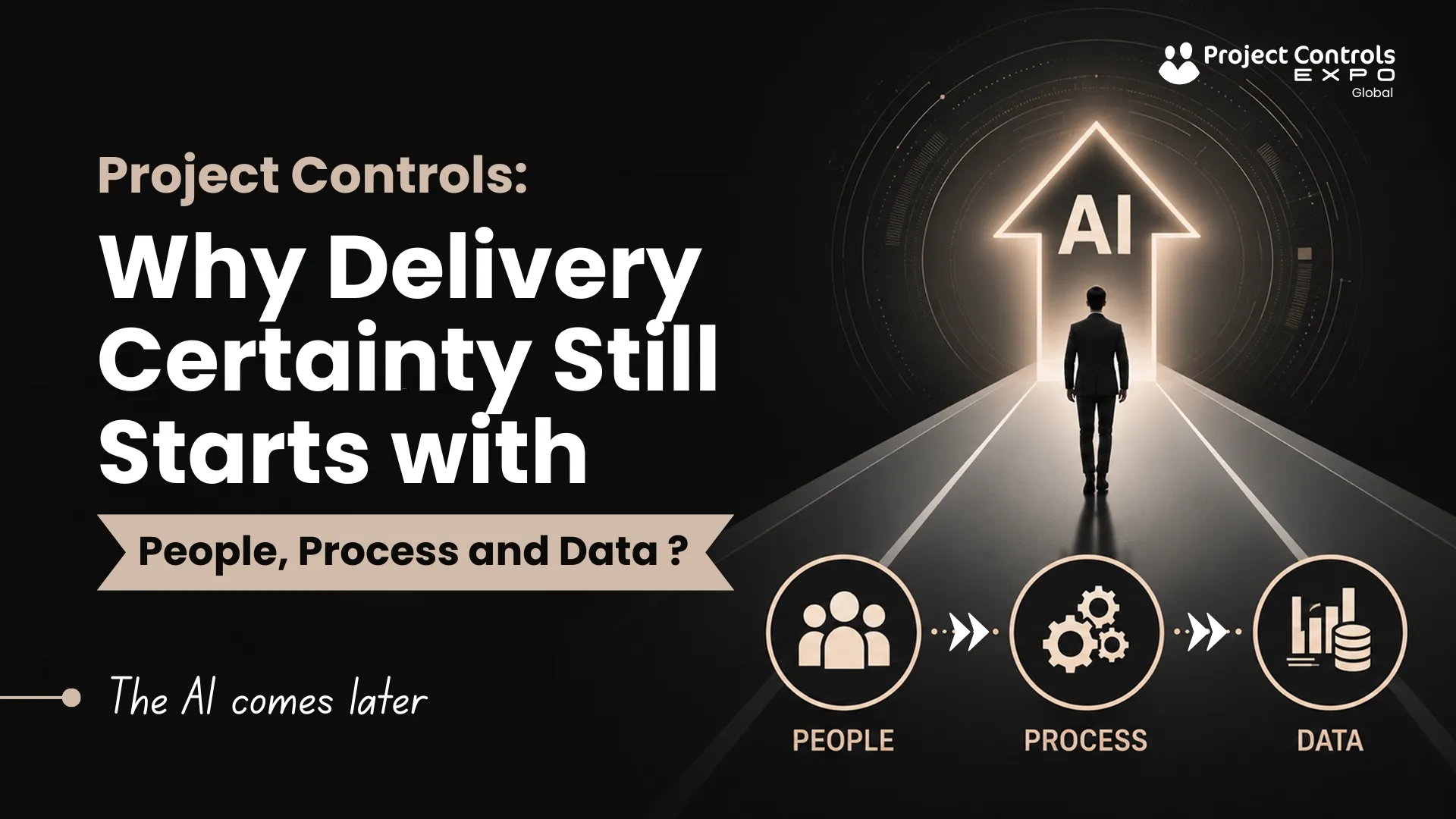
Every few years, our profession experiences a wave of change that promises to transform project delivery. Today, that wave is Artificial Intelligence (AI).
Almost every conference, webinar and boardroom discussion revolves around AI, automation and digital transformation. But amid all the excitement, an important question remains:
Are we focusing on the technology, or are we focusing on better project delivery?
The answer should always be the latter.
At its heart, Project Controls is the discipline that brings predictability, accountability and delivery certainty to projects.
It is the mechanism that enables organisations to understand where a project stands today, where it is heading tomorrow, what risks may prevent success, and what interventions are needed before issues become critical.
Planning, scheduling, cost management, risk management, change control, forecasting and performance reporting all come together to provide decision-makers with timely, reliable insights.
I often describe Project Controls as the GPS for project delivery. It does not drive the project, but it provides the visibility needed to make informed decisions and adjust course before it is too late.
The best Project Controls teams do far more than produce reports — they enable better decisions.
AI is undoubtedly one of the most significant developments our profession has seen. However, AI is not the solution to every problem — it is an accelerator.
Across industries, projects are becoming larger, more complex and increasingly data-intensive. Organisations are under pressure to improve productivity while facing skills shortages and tighter delivery expectations.
This is where AI offers enormous potential. It can automate repetitive reporting, analyse huge volumes of project data, detect trends that humans may overlook and provide predictive insights that support proactive decision-making.
Yet there is one important reality that organisations must recognise:
AI does not fix weak Project Controls — it exposes weaknesses faster.
If governance is poor, if data quality is inconsistent or if reporting processes lack discipline, AI will simply produce inaccurate insights more quickly.
Technology cannot compensate for weak foundations.
The future is not about replacing professionals with machines. It is about combining human intelligence with artificial intelligence to make better decisions.
The profession has evolved significantly over the past few decades.
The role of Project Controls is shifting from recording historical performance to predicting future outcomes.
This evolution is also changing the skills required within the profession. Administrative activities will increasingly be automated, allowing professionals to focus on interpretation, stakeholder engagement, critical thinking and strategic decision support.
The future Project Controls professional will need to combine technical capability with business acumen and analytical judgement.
Some of the most successful organisations I have worked with share common characteristics.
Digital transformation should therefore begin with culture, governance and structured data — not with technology procurement.
Project Controls is entering one of the most exciting periods in its history.
AI will undoubtedly transform how projects are planned, monitored and controlled. Routine administrative tasks will become increasingly automated, enabling professionals to dedicate more time to solving complex problems and supporting executive decision-making.
However, the organisations that will benefit most from AI will not necessarily be those with the biggest technology budgets.
They will be the organisations that first invest in:
Because ultimately, successful project delivery is not about technology — it is about making better decisions.
And while AI may help us make those decisions faster, the responsibility for making the right decisions will always remain a human one.
United States


